
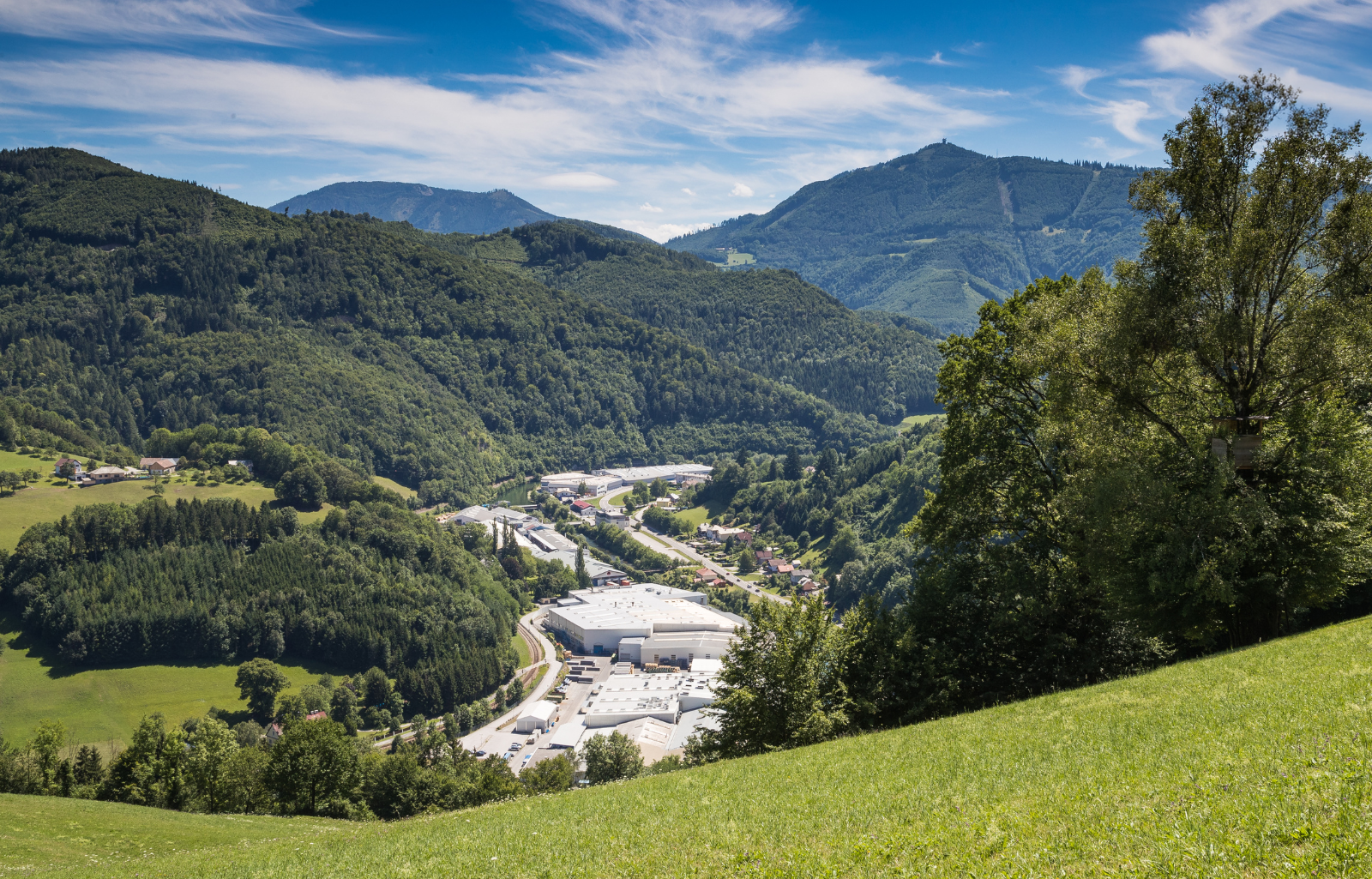
Neuman Aluminium recently completed the refurbishment of a furnace at their Marktl headquarters in Austria. The aim of the project was to update the furnace with a new stirring system to allow for the increased utilization of scrap in its portfolio of aluminum slugs, which are used in impact extrusion for packaging and technical applications.
Company Profile
Neuman Aluminium has a long company history going back to 1780, when a hammer mill was established in Marktl, nestled in the Traisen Valley in Lower Austria. Over the following centuries, the site evolved from a traditional metalworking operation into a modern industrial manufacturing center. In 1941, Neuman entered the aluminum business, with the introduction of aluminum rolling and impact extrusion operations in Marktl. This also led to the production of the first aluminum slugs at the site. This development began the transformation of the company into a global specialist for aluminum forming and processing.
In 1991, Neuman Aluminium was acquired by the Grupp family — a major milestone in the company’s modern development. Since then, Neuman Aluminium has been part of the family-owned CAG Holding Group, led by Dr. Cornelius Grupp, which has supported significant investments and international expansion.
“Over the decades, Neuman continuously expanded its aluminum business,” said Oliver Glitzner, managing director of Neuman Aluminium Austria GmbH. “Starting from slug production located in Austria, the company built additional capabilities in casting, forging stock production, impact extrusion, direct extrusion, machining, and complex component manufacturing. International growth led to the establishment of new production sites, creating a global manufacturing network serving customers around the world.”
Today, Marktl remains the headquarters and historical heart of Neuman Aluminium. The company operates ten manufacturing plants located in Marktl, Austria; Žarnovica, Slovakia; Waynesboro, VA, U.S.; Lagos de Moreno, Mexico; and Suzhou and Xinhui, China. It employs approximately 2,500 people worldwide and supplies customers in around 100 countries.
Together, these facilities provide a broad value chain, ranging from aluminum melting and casting to the production of semi-finished products and highly engineered aluminum components. Its core product portfolio includes aluminum slugs for packaging and technical applications, forged billet stock, impact-extruded components, direct-extruded profiles, and value-added machined and assembled parts. The company primarily serves the packaging, mobility, construction, and electrical engineering industries. Its products can be found in applications ranging from aerosol cans, tubes, and closures to defense products, automotive safety components, battery systems, sensor housings, heat sinks, structural parts, and architectural applications.
Overview of the Marktl Facility
The Marktl site combines the company’s corporate functions, research and development activities, and several manufacturing technologies within one integrated aluminum production campus. The site houses four business operations, including Neuman Aluminium Austria GmbH (the casting division), Neuman Aluminium Fließpresswerk GmbH (the impact extrusion division), Neuman Aluminium Strangpresswerk GmbH (the direct extrusion division), and Fried. v. Neuman GmbH (which provides central management and coordination functions for the group). Together, these four operations employ approximately 700 people and process around 80,000 tonnes of aluminum per year.
“The unique combination of casting, impact extrusion, and direct extrusion technologies at a single location enables Neuman to cover a substantial portion of the aluminum value chain, from recycling and melting through to highly engineered finished components,” noted Glitzner. “The site produces aluminum slugs for packaging and technical applications, forged billet stock for automotive applications, impact-extruded components and direct-extruded profiles, complemented by extensive machining, heat treatment, testing, and assembly capabilities.”
Neuman Aluminium Austria GmbH supplies a portion of its production to its own impact extrusion division in Marktl, where aluminum slugs are used as feedstock for the manufacture of technical impact extruded components. However, the majority of the casting division’s slug production is supplied to external customers, serving the European packaging industry in particular.
Manufacturing Aluminum Slugs
For the production of aluminum slugs used in impact extrusion, the Marktl plant first melts down the recycled material, which is then poured into a continuous strip casting machine. The strip is hot and cold rolled to obtain the desired strength before the desired slug shapes are punched out of the metal. Depending on the customer’s requirements, the slugs will receive a surface treatment (either blasted or scrubbed).
“Impact extrusion slugs must meet a unique set of requirements driven by the final application,” explained Glitzner. “A good example is an aluminum slug for a deodorant aerosol can. Although it may appear to be a simple product, the finished aerosol can is in fact a highly engineered component. It must meet demanding safety requirements, because it serves as a pressure vessel that is typically filled with compressed and often flammable propellants. At the same time, it must offer an attractive appearance and excellent surface quality to meet consumer expectations at the point of sale.”
Sustainability has become a major driver of innovation in slug production. Over the past decade, significant development efforts have been made in the design of new alloys and improvements in production technology to increase the share of post-consumer recycled aluminum, while simultaneously reducing the amount of material required for each can.
These sustainability requirements place very specific demands on slug production. Neuman has found that customers expect high levels of post-consumer recycled content, along with extremely tight alloy composition tolerances, uniform material properties throughout the slug, excellent melt cleanliness, and freedom from inclusions, oxides, and other metallurgical defects. In addition, the slugs need to provide precise weight and dimensional tolerances, excellent surface quality, and consistent formability during high-speed impact extrusion.
“The increasing use of recycled aluminum makes these requirements even more challenging,” said Glitzner. “Maintaining the highest quality standards while maximizing scrap utilization requires advanced melting and melt treatment technologies. This is one of the reasons why innovations in chip recycling and melting technology have become strategically important for modern slug production.”
Increasing Scrap Recovery
Neuman Aluminium initiated a major retrofit of its existing melting furnace. “The main driver was the increasing demand from customers for products containing higher levels of post-consumer recycled (PCR) aluminum,” said Michael Vonwald, technical director at Neuman Aluminium Austria. “Meeting these expectations requires a continuous transformation of our melting and recycling processes.”
The project involved a number of improvements to the furnace, including renewal of the door system, relining of the refractory lining, an enlargement of the bath surface area, and an increase in holding capacity. In addition, a Typhoon™ chip submersion system from Zmag was installed and modifications were made to the heat recovery system to prepare for the future preheating of scrap intended for stirring into the melt.
One key aspect of the project was the new submersion system, since many post-consumer scrap streams consist of small, lightweight fractions with low bulk density. “To process these materials efficiently, we were looking for a submerging technology that could be integrated into our existing furnace and enable submerged melting of these challenging scrap types,” explained Vonwald. “The Typhoon system provided exactly this solution. It significantly expands the range of scrap materials we can process economically and efficiently, giving us much greater flexibility in raw material sourcing while supporting our sustainability goals.”
The Typhoon submersion technology is driven by Zmag’s proprietary zPMC™ (Zmag Permanent Magnetic Circuit), which creates “virtual impellers” thanks to the magnetic field it generates. As a result, the system operates with only 5–15 kW of power, including air cooling blower, while submerging up to 5 tons per hour of machining chips. In addition, this contactless stirring method eliminates mechanical wear, resulting in a maintenance free, energy efficient, and operator friendly solution.
The Typhoon generator is equipped with a gearmotor controlled by a single variable frequency drive (VFD), allowing precise adjustment of vortex intensity and molten aluminum flow within its well. When chips or alloying materials are not being charged, the system can operate quietly at low intensity to minimize dross formation, while maintaining bath homogeneity and achieving reported recovery rates above 99%.
Installing the Typhoon came with some risks due to it being a novel application. “To the best of our knowledge, Neuman was the first company in Europe to install Zmag Typhoon technology,” noted Vonwald. “In addition, no previous installation of a Typhoon system had been made on a tiltable single-chamber melting furnace worldwide, making the project something of a pioneering application.”
Another unique aspect of the project was that Neuman’s furnace is primarily operated as a solid-charge melting furnace, with the Typhoon system acting as an additional melting unit rather than the primary melting source. As a result the system runs with significantly lower molten aluminum temperatures than in a common chip-melting furnace.
Naturally, the company had some technical concerns before the project started. “These included the suitability of the system to melt the targeted rates for our scrap portfolio, the risk of clogging at the metal passages connecting the well to the furnace, and the operator effort required for cleaning and dross handling,” said Vonwald. “We also closely monitored potential for metal splashing during charging operations and any possible impact on melt quality and final product quality.”
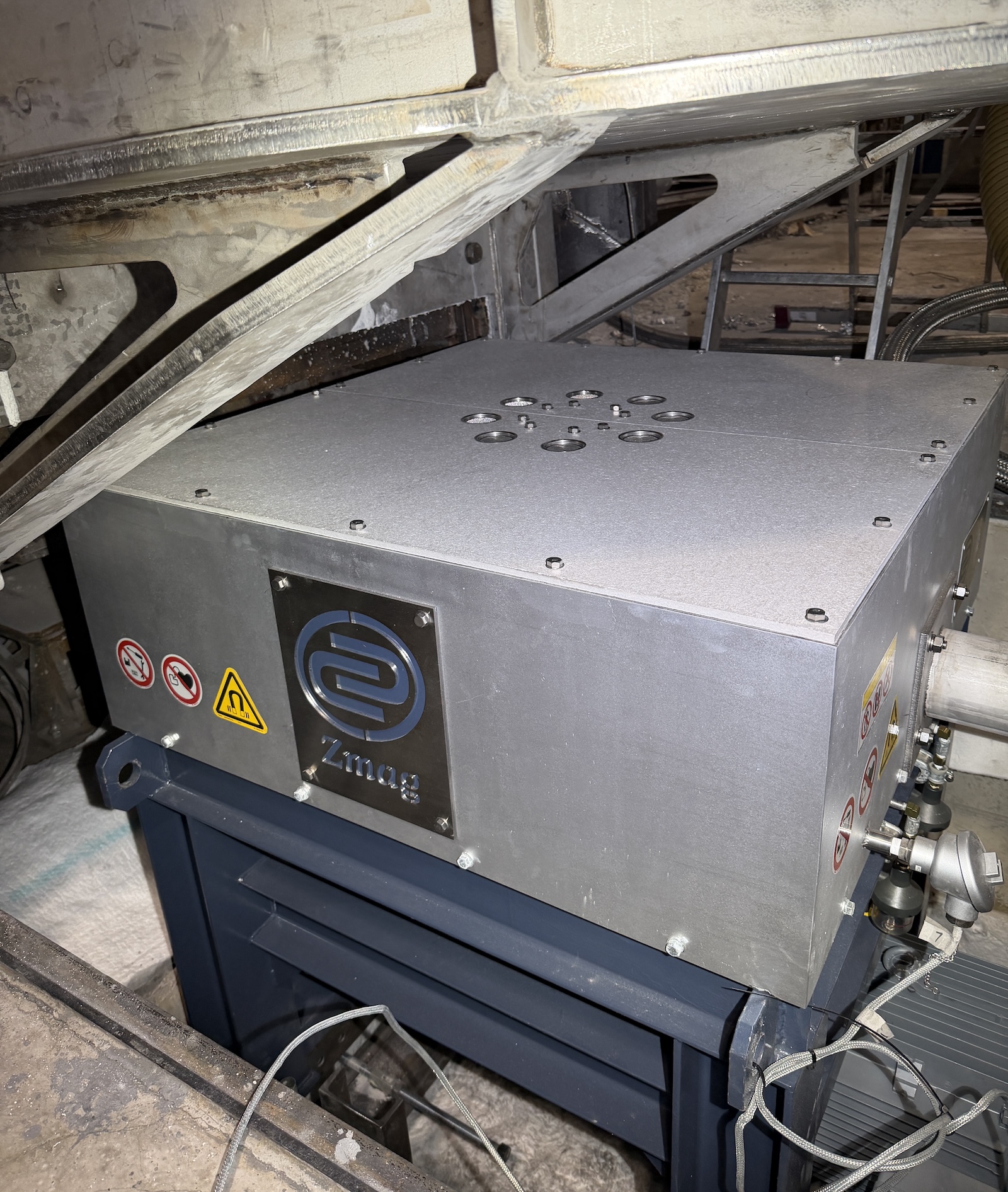
To install the submersion system, the furnace sidewall was opened and a sidewell was added to enable the submerged melting process (Figure 1). In addition, the foundation had to be extended to create a pit for the magnetic generator (Figure 2), which is a core element of the Typhoon technology. The sidewell is positioned above the permanent magnet generator, separated by a small air gap. As a result, when the furnace tilts, the action is able to fully empty the well. Meanwhile, the generator remains fixed to the floor.
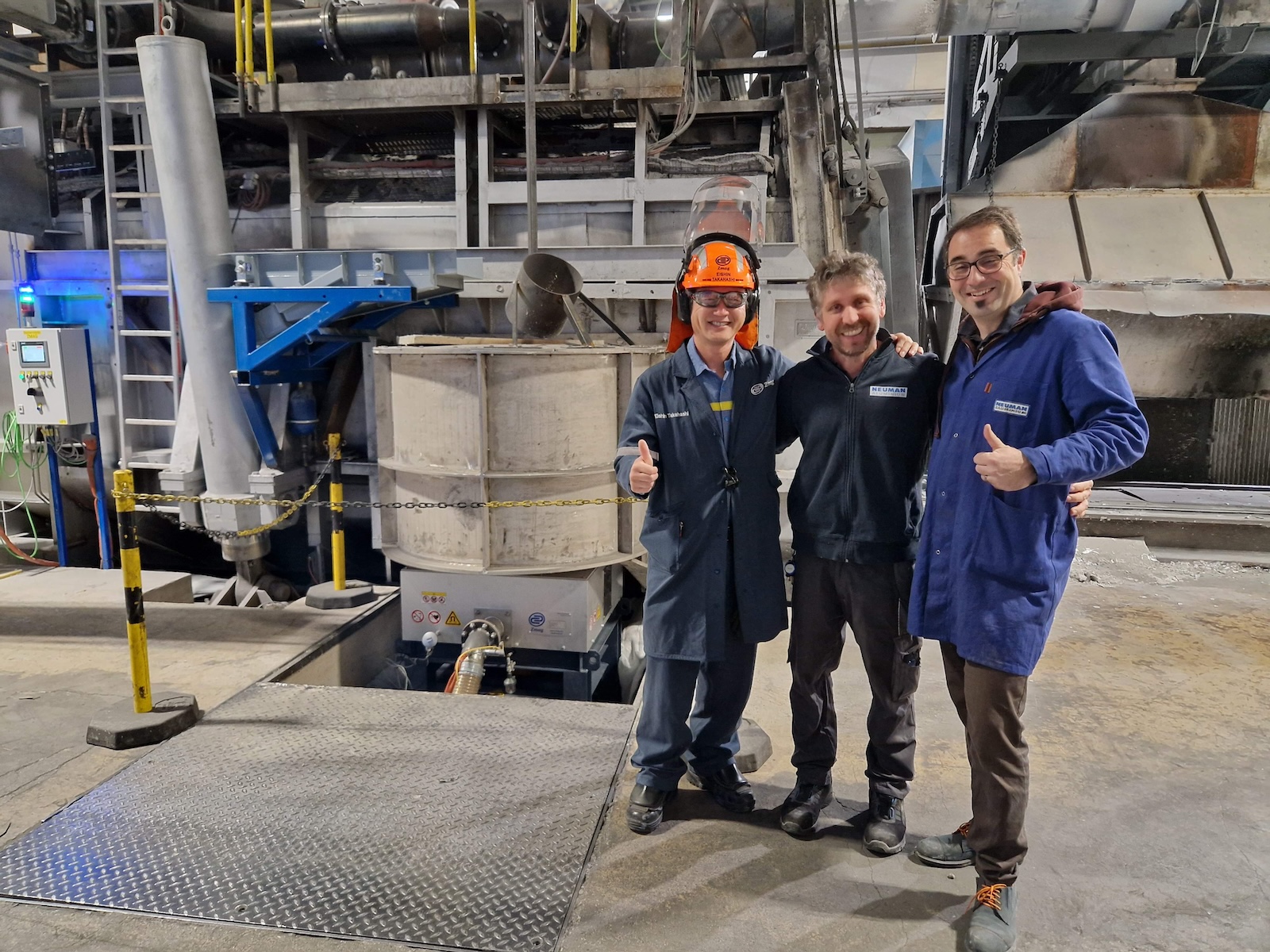
Vonwald expressed appreciation for Zmag’s support throughout the project, including their professionalism, speed, openness, mutual respect, and a genuine commitment to finding solutions together. “As a result, the implementation was ultimately smoother and more successful than initially anticipated,” he said. “And because these modifications were implemented as part of the planned furnace modernization, the additional effort required for integrating the submersion system remained well within the overall scope of the retrofit project.”
Results
The results of implementing the Typhoon submersion system exceeded Neuman’s expectations. The original target was for the system to achieve a melting rate of 1 tonne per hour for scrap with a bulk density of approximately 375 kg/m³, while continuing to melt solid charge materials (such as ingots) in parallel within the same furnace. During operation, the system was able to process almost twice the planned scrap quantity in the expected time (Figure 3), while maintaining normal furnace operation.
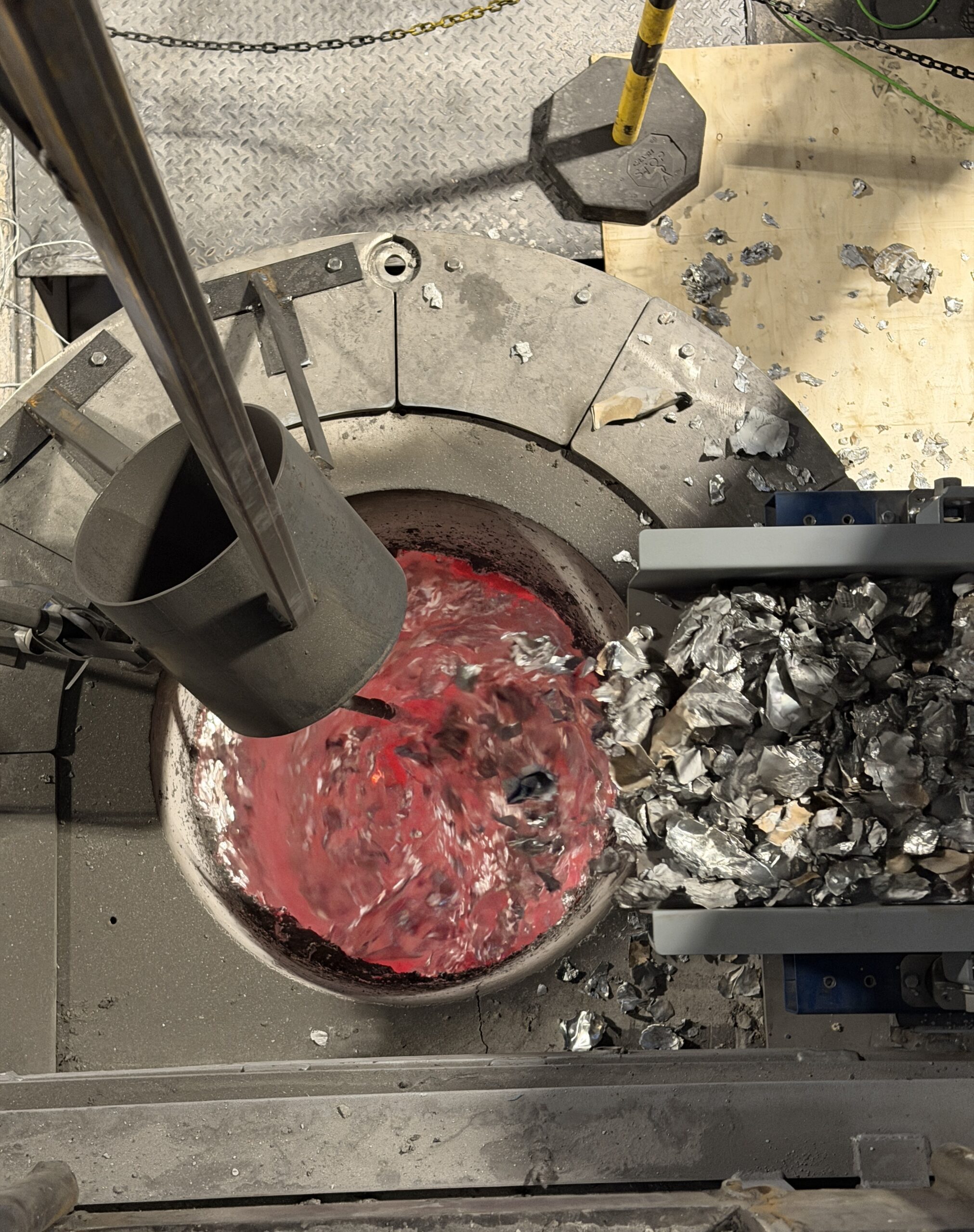
In addition, the system achieved the required melting performance without creating additional operational burdens. The company found that operator involvement remained very low, furnace operation stayed stable, and no negative impacts on the melt or finished product quality was observed.
“The project has delivered exactly what we were looking for,” said Vonwald. “We saw a substantial increase in our ability to process low-density recycled scrap, significantly greater flexibility in our raw material portfolio, and the confidence that these benefits can be achieved without compromising product quality or operational stability.”
An additional benefit of the new system quickly became apparent on the shop floor. “Our operators recognized that the Typhoon system is not only an effective tool for melting low-density scrap, but also an excellent means of introducing alloying elements into the melt,” noted Vonwald. “The intensive bath movement generated by the system enables alloying additions to be distributed rapidly, efficiently, and homogeneously throughout the furnace, supporting both process stability and metallurgical consistency.”
Conclusion
For Neuman Aluminium, continuous improvement is an essential part of its business. Over the past several years, the company has invested in a range of modernization projects across both of its core products (slugs and forging billets production), including investments in production equipment, process automation, recycling capabilities, digitalization, and infrastructure upgrades. These improvements have focused on increasing process efficiency, improving sustainability, enhancing product quality, and strengthening operational reliability. The recent furnace upgrade with the installation of the Typhoon system is just one example of the company’s broader strategy.
“The world around us is changing rapidly,” said Glitzner. “Customer requirements, sustainability expectations, energy markets, supply chains, and regulatory frameworks continue to evolve, creating both challenges and opportunities for manufacturing companies. The future belongs to companies that can adapt faster than their environment changes. At Neuman, speed and flexibility are deeply embedded in our culture. We intend to use those strengths to continuously transform our business and seize new opportunities as markets, technologies, and customer expectations evolve.”
Editor’s Note: This article first appeared in the October 2026 issue of Light Metal Age. To receive the current issue, please subscribe.