
By J.P. Weiler, Meridian Lightweight Technologies, Inc.
Magnesium alloys have historically been associated with lightweighting applications in automotive and aerospace systems due to their low density, high specific strength, dimensional stability, and castability. The use of magnesium alloys in transportation systems expanded significantly during periods of increased emphasis on fuel economy and vehicle mass reduction, particularly within automotive structural applications. More recently, magnesium developments have also been linked to vehicle electrification, where lightweighting continues to provide benefits associated with driving range, battery efficiency, and system-level mass reduction.
Over the past several years, magnesium has also become an increasingly important topic within critical minerals policy and industrial supply chain resilience discussions. This shift reflects changing priorities within global manufacturing industries, where supply chain security, domestic processing capability, industrial resilience, and geopolitical risk now influence material strategy alongside traditional engineering and cost considerations.
A critical mineral is generally defined as a material that is both economically important and subject to significant supply chain vulnerability. While definitions vary between jurisdictions, most national critical mineral strategies evaluate materials according to their economic importance, role in strategic industries, concentration of global supply, processing capability, and susceptibility to supply disruptions.1
Historically, critical mineral discussions focused primarily on materials associated with batteries, semiconductors, permanent magnets, and defense, including lithium, cobalt, graphite, gallium, and rare earth elements. More recently, magnesium has been incorporated more prominently into these discussions due to the concentration of global production capacity and its importance to transportation, aluminum production, and defense applications.
The increased focus on magnesium reflects several industrial and geopolitical developments. Primary magnesium production remains highly concentrated geographically, with China accounting for roughly 90% of global primary magnesium production. This concentration creates significant supply chain vulnerability for North American and European manufacturing industries.
Governments are prioritizing domestic manufacturing capability and strategic industrial independence following recent supply chain disruptions associated with geopolitical instability, transportation constraints, and energy-related production curtailments. In parallel, transportation electrification and decarbonization policies continue to increase interest in lightweight structural materials capable of improving vehicle efficiency and extending EV driving range. Several governments now consider critical mineral supply chains as components of national security and industrial policy rather than solely commercial commodity markets. As a result, magnesium is now being evaluated not only as a lightweight engineering material, but also as a strategically important industrial material requiring more resilient and diversified global supply systems.
Magnesium as a Critical Mineral
Magnesium’s inclusion in national critical mineral frameworks reflects its growing importance across several industrial sectors, including automotive and aerospace components, defense systems, and aluminum alloying additions. Magnesium is also becoming more strongly associated with electrification systems and clean energy technologies.
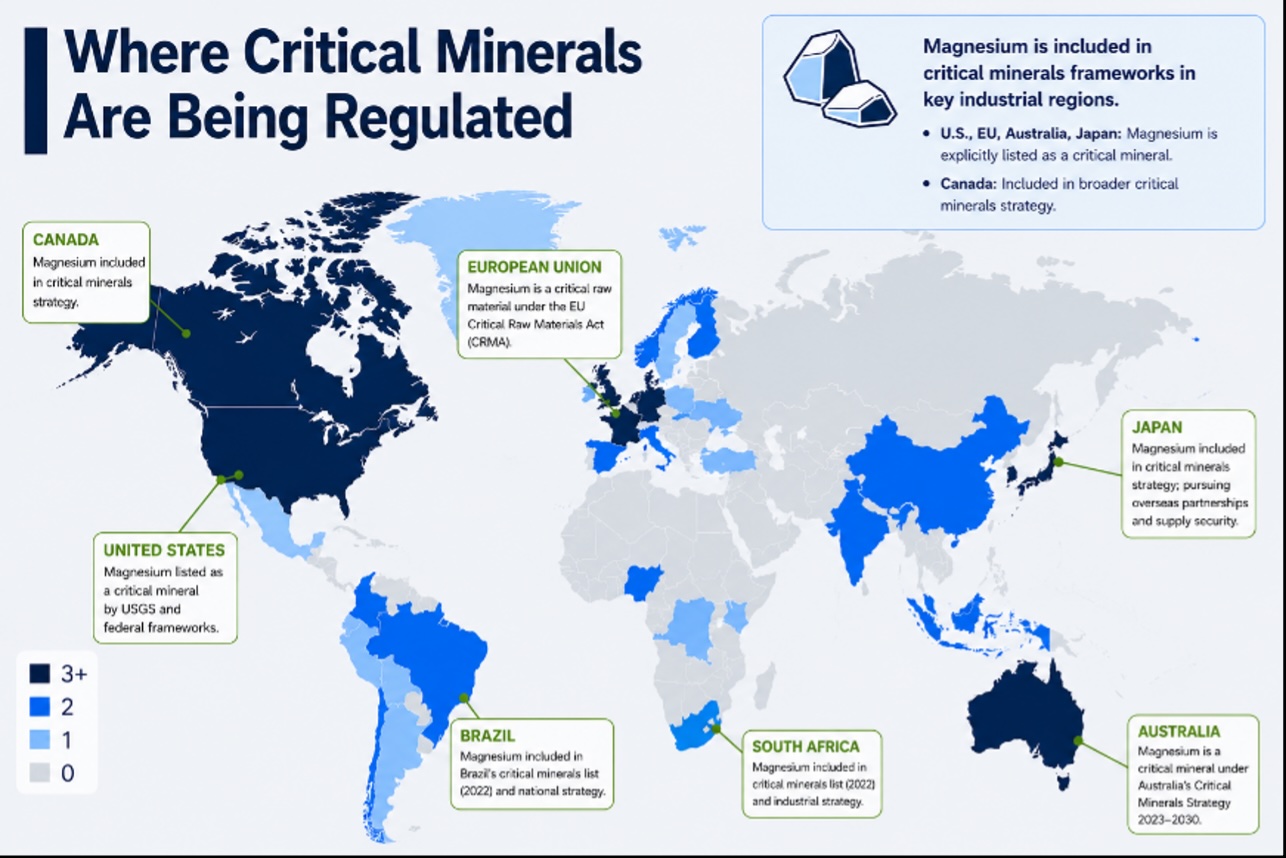
The U.S. Department of Energy (DOE) reaffirmed magnesium’s critical mineral status in 2025 based on its importance to transportation systems and advanced manufacturing.2 Similarly, Canada’s Critical Minerals Strategy includes magnesium within broader efforts to support clean technology supply chains and advanced manufacturing development.3 Australia has also identified magnesium as strategically important through its Critical Minerals List and its participation in the Minerals Security Partnership (MSP), which seeks to establish secure and sustainable allied mineral supply chains.4 The European Union continues to monitor magnesium supply risk through the Critical Raw Materials Act (CRMA), particularly following earlier periods of supply disruption and price volatility.5 The inclusion of magnesium within these frameworks demonstrates a broader shift in how governments view strategic minerals (Figure 1).
Global Trade Policies and Strategic Supply Chains
Trade policy is becoming a major factor influencing the magnesium industry. Tariffs, anti-dumping measures, export controls, and preferential trade agreements are now playing a significant role in shaping global magnesium supply chains. The U.S. maintains a complex tariff structure for magnesium products through the U.S. International Trade Commission (USITC), including duties on unwrought magnesium alloys, powders, and wrought products.6 In addition to standard tariffs, the U.S. continues to enforce anti-dumping duties on Chinese magnesium products, with some duties exceeding 100% depending on the producer and product category. These measures are intended to counteract unfair pricing practices, support domestic producers, and reduce dependence on highly concentrated foreign supply systems.
Conversely, preferential trade treatment is now being extended to allied nations participating in critical mineral development strategies. One example is Australia’s Latrobe Magnesium production project, which has received planned tariff exemptions under U.S. critical mineral provisions, allowing duty-free access to the U.S. market.7 These developments suggest a transition toward “friend-shoring” and allied supply chain development, where governments seek to secure strategic materials through politically aligned trade relationships rather than purely globalized commodity markets.
China’s dominance in magnesium production continues to create geopolitical and industrial sensitivity. In late 2024, China’s Ministry of Commerce introduced export controls on magnesium-based composite materials and powders used in strategic industrial applications.8 Although portions of these restrictions were later temporarily suspended during trade negotiations with the U.S., the events reinforced the strategic importance of magnesium and demonstrated how export controls have the potential to rapidly affect downstream manufacturing industries.9 As a result, governments are supporting domestic magnesium production, recycling infrastructure, allied supply chain diversification, and strategic mineral stockpiling initiatives.
U.S.
The U.S. now links critical mineral policy with industrial resilience, national security, and defense manufacturing capability. The Defense Production Act (DPA) has been used more extensively to support critical mineral development initiatives associated with domestic industrial capability. The U.S. Department of Defense has also expanded funding for magnesium-related research programs associated with lightweight military vehicles, aerospace systems, and advanced manufacturing technologies.10
In parallel, the U.S. DOE launched a Critical Materials Innovation Program in 2025, which allocated approximately $150 million toward projects associated with magnesium recovery from mine waste and industrial byproducts.11 The initiative reflects broader policy objectives intended to reduce dependence on imported magnesium while supporting domestic industrial capability and lower-emission production technologies.
Historically, the U.S. possessed greater domestic magnesium production capability. Over time, however, international competition and global production economics contributed to increasing reliance on imported material. Recent policy developments suggest greater emphasis on domestic refining and processing capability, recycling and secondary recovery, and downstream manufacturing integration. Two examples are the proposed TETRA Technologies and Magrathea Metals project in Arkansas, which specifically references magnesium’s strategic importance to U.S. industrial and defense supply chains,12 and the Big Blue Technologies project in Wyoming.13 Collectively, these developments indicate that magnesium is no longer viewed solely as a commercial material, but as a strategic industrial resource requiring domestic and allied production capability.
Canada
Canada’s Critical Minerals Strategy positions the country as a long-term supplier of strategically important materials to allied economies. Canada is well positioned for future magnesium supply chain development because of its established mining and metallurgical expertise, integration with North American automotive manufacturing, and access to low-carbon electricity systems. Canada’s Critical Minerals Infrastructure Fund supports transportation and processing infrastructure associated with magnesium and other strategic minerals.14 The program prioritizes projects located in northern and remote regions while emphasizing Indigenous partnerships and environmental performance. Canada’s Growth Fund has also supported magnesium recycling initiatives intended to reduce reliance on primary extraction while lowering greenhouse gas emissions intensity.15
Recent developments associated with the Minago Critical Minerals Project in Manitoba further demonstrate the growing strategic importance of magnesium within Canadian critical mineral policy. In 2026, Minago Development signed a licensing agreement granting exclusive Canadian rights to Big Blue Technologies’ aluminothermic reduction (ATR) magnesium extraction process. The project proposes magnesium extraction from dolomite associated with the Minago nickel and platinum group metals deposit. The initiative aligns closely with broader Canadian policy objectives associated with domestic low-carbon mineral production for strategically important materials.16
European Union
The European Union formally classified magnesium as a critical raw material under the CRMA,5 which establishes several quantitative targets intended to reduce dependence on concentrated foreign supply chains. This includes objectives requiring 10% of annual demand to be sourced through domestic extraction, 40% to be processed within Europe, and 25% to be supplied through recycling, while limiting dependence on any single third-country supplier to less than 65%.5
These targets are particularly important for magnesium because Europe has historically depended heavily on imported material. European concern intensified following periods of production curtailments and export restrictions that created significant uncertainty within automotive and manufacturing industries. As a result, European policy now emphasizes domestic processing capability, recycling systems, strategic stockpiling, allied sourcing partnerships, and supply chain transparency. The European approach also integrates critical mineral policy with broader industrial decarbonization objectives, including Scope 3 emissions reduction and circular economy development.
As a result, future magnesium sourcing decisions within Europe may place greater emphasis on embedded carbon emissions in addition to traditional cost and performance considerations. This may create long-term advantages for lower-emission magnesium production systems utilizing hydroelectric, renewable, or recycled feedstocks. Within the framework of the CRMA, the European Union is also establishing a pipeline of strategic projects aimed at strengthening the supply of strategic raw materials. To date, Verde Magnesium in Romania has been granted Strategic Project status, recognizing its potential contribution to enhancing Europe’s security of magnesium supply.
Australia
Australia’s Critical Minerals Strategy 2023–2030 includes magnesium within broader efforts to expand domestic processing capability and allied supply chain development.4 Historically, Australia’s mining industry focused primarily on raw material extraction and export. More recent policy initiatives increasingly emphasize downstream processing capability, low-carbon refining technologies, and strategic industrial partnerships.
One of the most visible magnesium initiatives is the Latrobe Magnesium project, which utilizes fly ash from coal-fired power stations as a feedstock for magnesium production.7 The project demonstrates low-emission magnesium production from industrial waste streams while contributing to diversification of global magnesium supply. Australia has also committed funding toward exploration programs intended to identify additional magnesium resources, particularly in Western Australia and Queensland.4 The broader Australian strategy positions critical minerals policy as an industrial development mechanism intended to support domestic refining capability, export-oriented processing industries, and long-term partnerships with allied manufacturing economies.
Japan
Japan’s critical mineral strategy remains heavily focused on long-term supply chain security and diversification due to limited domestic mineral resources. Japanese industrial policy emphasizes overseas investment, strategic partnerships, and long-term supply agreements for critical materials associated with transportation, electronics, and advanced manufacturing industries.
Japan has expanded cooperation with Australia and other allied nations through critical mineral agreements intended to support stable supply chains for strategically important materials, including magnesium and high purity powders.17 This approach reflects Japan’s broader industrial strategy of reducing dependence on concentrated foreign supply systems through coordinated government and industrial investment. Collectively, these regional strategies demonstrate increasing convergence between critical mineral policy, industrial decarbonization objectives, and long-term manufacturing security.
Environmental and Regulatory Considerations
Environmental permitting and regulatory approval timelines remain important considerations for future magnesium development projects. Current permitting timelines vary among different authorities, with major mining and processing projects requiring approximately 7-10 years in North America, and three to five years in Australia. All major jurisdictions now emphasize ESG compliance, responsible sourcing, recycling, and emissions reduction. At the same time, several governments are attempting to accelerate permitting processes for strategically important critical mineral projects in response to growing concern regarding supply chain vulnerability.
Industrial Implications and Strategic Direction
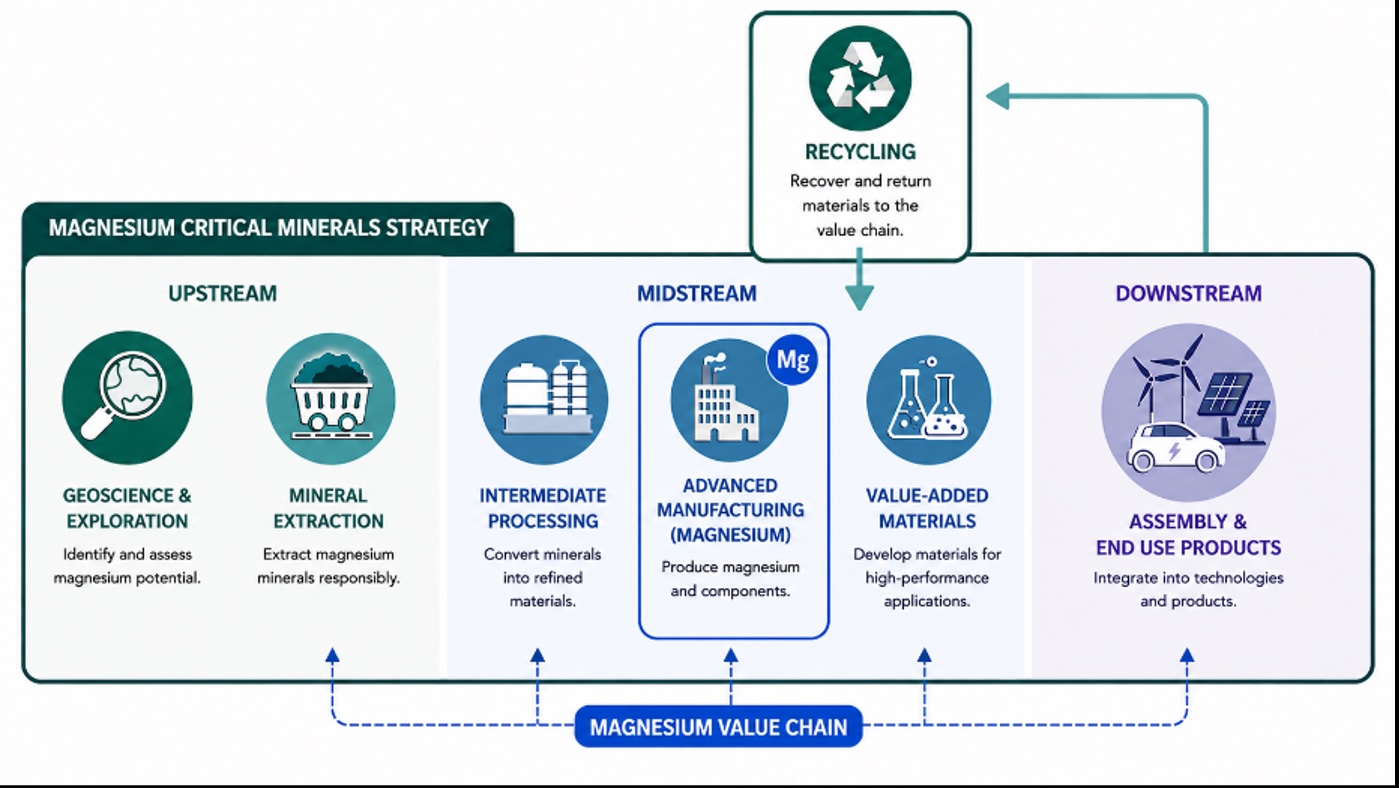
Several common trends are now visible across global magnesium and critical mineral policy frameworks. Governments are prioritizing domestic processing capability rather than focusing solely on raw material extraction. This includes refining, alloy production, recycling, and downstream manufacturing integration. Carbon intensity is also becoming a major consideration in future magnesium supply chains. Governments and OEMs now evaluate emissions performance, renewable energy integration, recycling content, and Scope 3 emissions when assessing future sourcing decisions. Recycling and secondary magnesium recovery are receiving increased attention due to their potential to reduce dependence on imported primary material, lower emissions intensity, and improve supply chain resilience (Figure 2). In parallel, global magnesium supply chains are becoming more regionalized through allied partnerships and “friend-shoring” initiatives, significantly influencing future investment decisions.
Conclusion
The classification of magnesium as a critical mineral represents a significant shift in the factors influencing the global magnesium industry. Historically, magnesium development was driven primarily by lightweighting requirements associated with automotive and aerospace applications. More recently, supply chain security, geopolitical considerations, and industrial resilience have become major drivers of government policy and industrial investment. Countries including the U.S., Canada, members of the European Union, and Australia are implementing policies intended to diversify magnesium supply chains, and support domestic or allied production capability, to help reduce dependence on concentrated foreign supply.
At the same time, trade measures, export controls, government funding programs, and industrial incentives are increasingly shaping the future structure of the magnesium industry. For magnesium producers, recyclers, die casters, and downstream manufacturers, the transition from lightweight engineering material toward strategically important industrial material may create significant opportunities. As governments continue integrating critical mineral policy with industrial development objectives, magnesium’s role within future global manufacturing systems will likely continue expanding.
References
- “Critical Raw Materials,” European Commission.
- “Critical Minerals and Materials Program,” U.S. DOE.
- “Canadian Critical Minerals Strategy,” Government of Canada, 2022.
- “Critical Minerals Strategy 2023–2030,” Australian Government.
- “Critical Raw Materials Act (CRMA),” European Commission.
- “Harmonized Tariff Schedule – 2026 HTS Revision 9,” U.S. International Trade Commission (USITC).
- Latrobe Magnesium, www.latrobemagnesium.com.
- “China to impose export controls on certain magnesium materials from Dec 1,” Asian Metal, 2024, and China’s Ministry of Commerce.
- “China Hits ‘Pause’ on Rare-Earth Export Controls and What it Means for Supply Chains,” Clark Hill, November 24, 2025.
- “DOD Awards $192.5 Million to Establish Domestic Manufacturing Capabilities for Critical Defense Chemicals,” U.S. Department of Defense, February 1, 2024.
- “Funding Notice: Critical Material Innovation, Efficiency, and Alternatives,” U.S. DOE, May 19, 2026.
- “Tetra Technologies, Inc. and Magrathea Metals, Inc. Advance Joint Venture Plans to Produce Magnesium in Arkansas,” Tetra Technologies, December 2, 2025.
- Madison, David, “Cheyenne Companies Plan Biggest Magnesium Operation in North America,” Cowboy State Daily, June 01, 2025.
- “Critical Minerals Infrastructure Fund,” Government of Canada.
- Canada Growth Fund, https://canadagrowthfund.ca.
- “Minago to be Canada’s First Producer of Magnesium,” Minago Critical Minerals Project, January 12, 2026.
- “Australia-Japan Joint Statement on Elevated Critical Minerals Cooperation,” Australian Government, May 4, 2026.
Editor’s Note: This article first appeared in the June 2026 issue of Light Metal Age. To receive the current issue, please subscribe.