
By Andrew Halonen, Mayflower Consulting LLC.
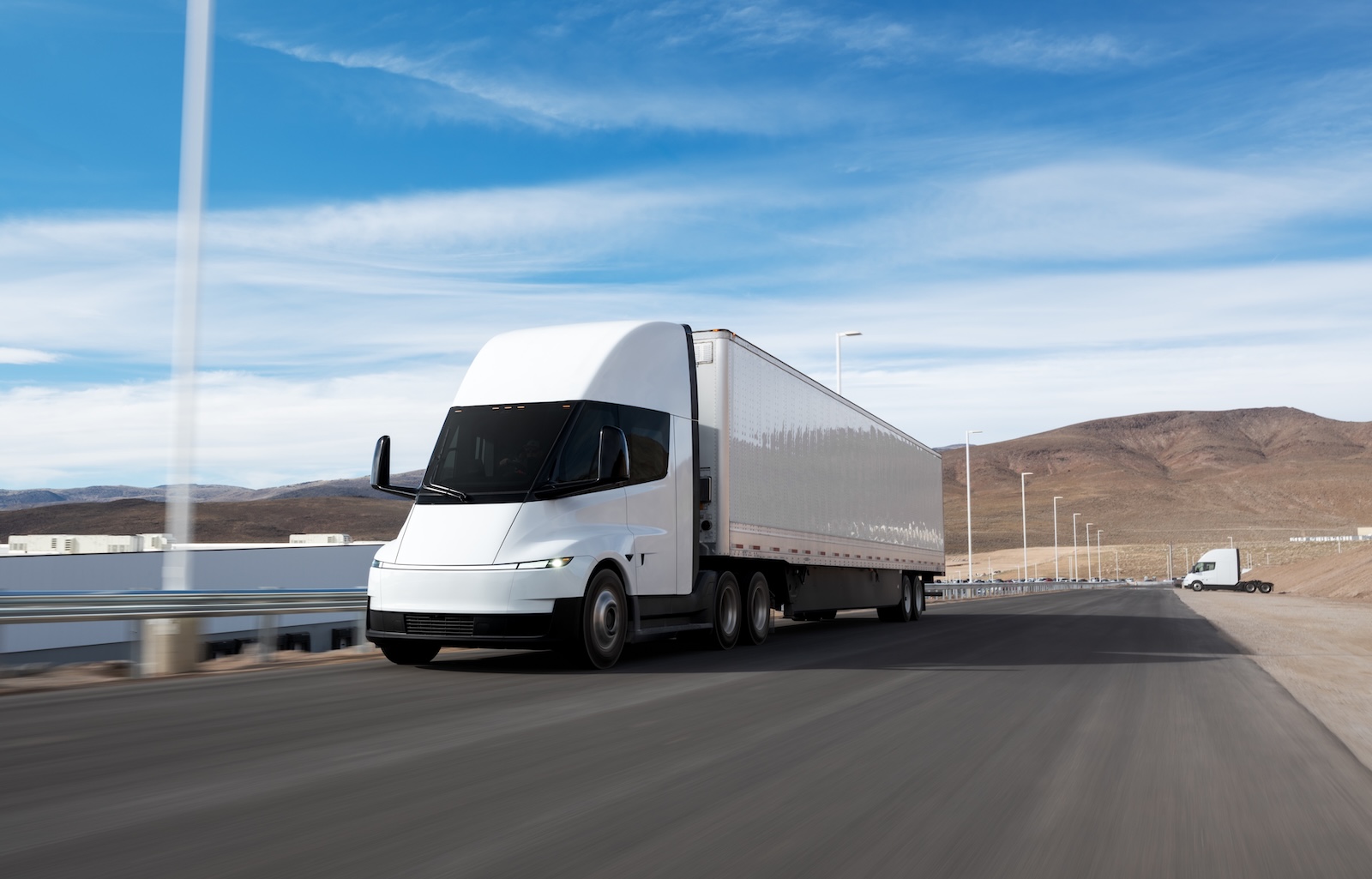
Heavy duty trucking is essential for shipping and delivering goods and materials to manufacturing plants, retail stores, and consumers, representing 70% of all freight in the U.S.1 Unfortunately, it is also inherently carbon intensive. According to MIT Climate Portal, 65% of global freight emissions are generated by road vehicles, like trucks and vans.2 In response, the industry has been exploring the possibility of electrifying heavy duty trucking — a goal that recently saw a major leap forward with the launch of the Tesla Semi 2.0, the latest version of Tesla’s electric semi-truck (Figure 1). In true Tesla style, the new semi-truck features an interesting mix of materials and technologies, some of which are industry-firsts.
Designing Trucks to Move Freight
In the passenger car market, a vehicle typically lasts for seven years before the design is refreshed, or the model is replaced entirely. In trucking, the models are refreshed about every 10-15 years. For example, the Peterbilt 389 was discontinued in December 2023 after 17 years of production.
When designing and engineering a freight vehicle that will be hauling heavy loads on the road for decades, there are many factors to consider. It’s a very different process from designing a passenger car for carrying people. Buyers of trucks are calculating the total cost of ownership (TCO) for their duty cycle. Weight of the load, distance traveled, upfront cost, resale cost, maintenance, and charging time are a few of the many factors to consider.
Another consideration on the truck manufacturer’s side is ROI, due to the much smaller production volumes compared to passenger vehicles. For example, Ford reported that its F-Series (including the best-selling F-150) sold 828,832 trucks in 2025.3 By comparison, the total number of Class 8 trucks built in North America is typically 200,000 trucks per year across the top brands, including Freightliner, PACCAR, International, and Volvo-Mack.
Heavy duty trucks are labeled either Class 7 (26,001–33,000 lbs) or Class 8 (33,001–80,000 lbs). A collage of materials is used in these trucks to ensure durability, utility, and light weight. The trailer walls and floor structures of the trucks have a lot of aluminum sheet and extrusion content,4 but the floors are also often made of wood or wood composites. Tractors and heavy duty towing units (basically the front end of a semi-truck) are mostly comprised of steel, with the exception of PACCAR’s aluminum cab and Freightliner’s aluminum doors. Meanwhile, the fairings (a hollow bonnet installed on the roof of truck cabs to make them more aerodynamic) are mostly polymer-based with metal reinforcements.
Despite the lower sales volumes for heavy duty trucks, the individual parts are larger. In addition, the models remain in production three times longer than passenger vehicles, which means that once a material (aluminum, steel, or polymer) is proven, it will have the inside track for decades to come.
The Tesla Semi
Tesla first introduced its Tesla Semi in 2017, with the aim of having the electric, heavy duty Class 8 trucks in production by 2019. However, the development of the truck went through multiple design iterations, causing delays. In 2022, a select group of customers (including notable brands, like Pepsi) received early versions of the Tesla Semi for testing. The company officially started mass production of the trucks, now called Tesla Semi 2.0, at its giga-factory in Sparks, NV, in May 2026.
The Tesla Semi features a unique aerodynamic design, with a coefficient of friction reported at 0.4 (compared to 0.54 for the Peterbilt, a competing model). Aerodynamics are a high priority, because less drag directly relates to more miles per unit of fuel. The design comes in two versions—Standard Range at <20,000 lbs, which delivers approximately 325 miles of range, and Long Range at 23,000 lbs with around 500 miles of range. As a result, the Tesla Semi 2.0 is designed for local and regional deliveries.
Both versions use a fast charging system, designed to provide up to 60% of range within 30 minutes.5 The design also features two rear drive axles, which are designed so that they can be shut off to reduce friction and increase driving range when hauling a light load.6 Like diesel trucks, the Semi is designed to run for a 1-million-mile lifespan before needing a major powertrain overhaul.
The cab is designed for the driver’s ergonomics and comfort. Unlike other trucks, the driver seat is in the middle. Combined with the large windshield and side windows, this gives the driver a generous view of the road and surroundings. Drivers reportedly love the Tesla Semi and other electric trucks, because they are quiet, powerful, responsive, and have a tight turning radius. Electric trucks don’t smell of fumes and allow for one-pedal driving with regenerative brakes.
Core Memory recently provided an inside look into the truck’s manufacturing with a video tour of Tesla’s vertically integrated giga-factory, which includes stamping and injection molding on-site.7 The video shows that Tesla engineers selected many lightweight components, in line with recommendations from the North American Council for Freight Efficiency’s (NACFE’s) lightweighting report,8 including aluminum air tanks, air disc brakes (which are lighter weight than drum brakes), cast aluminum mounts for the suspension and airbags, cast aluminum hubs, and forged aluminum wheels.
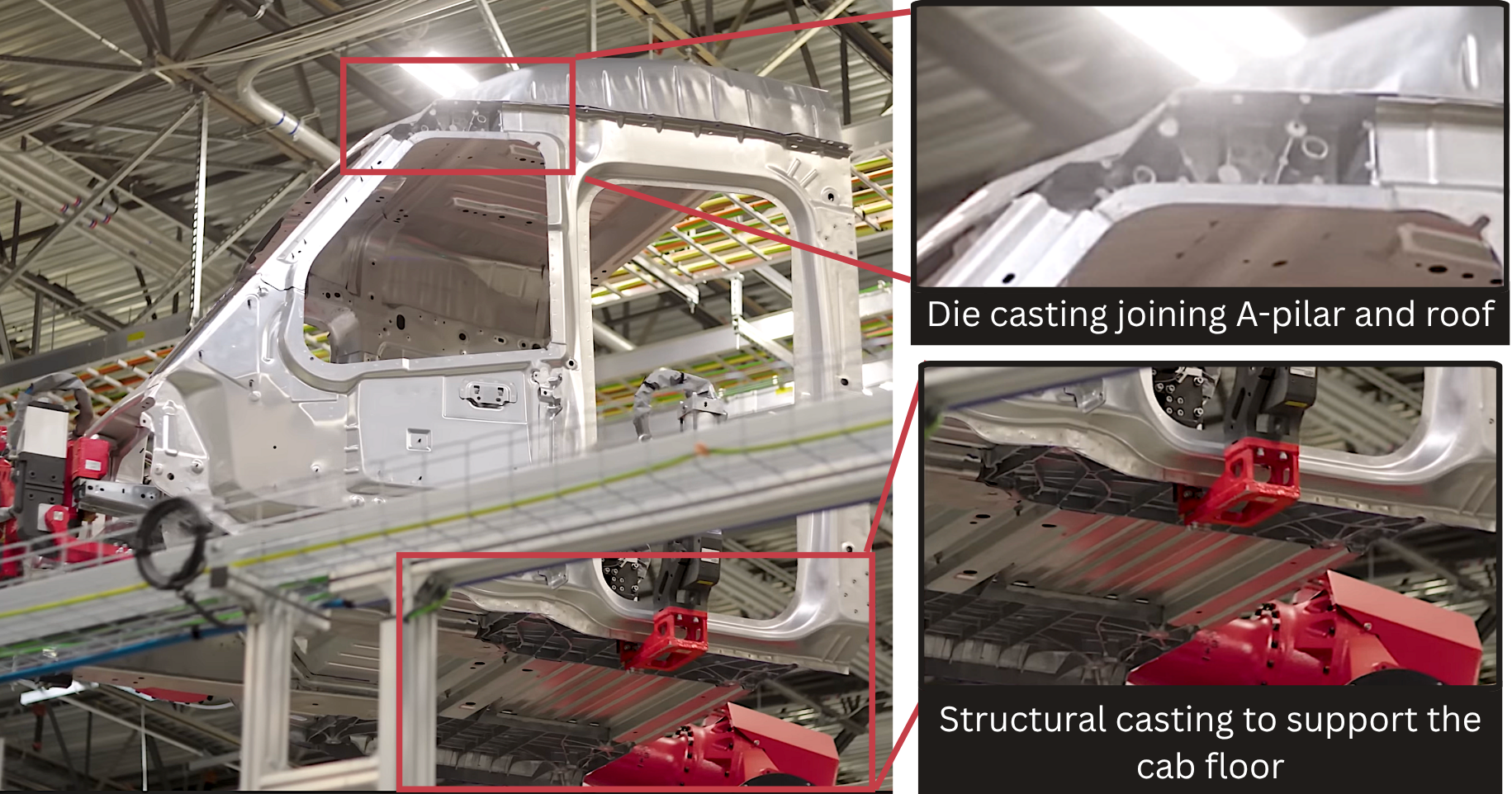
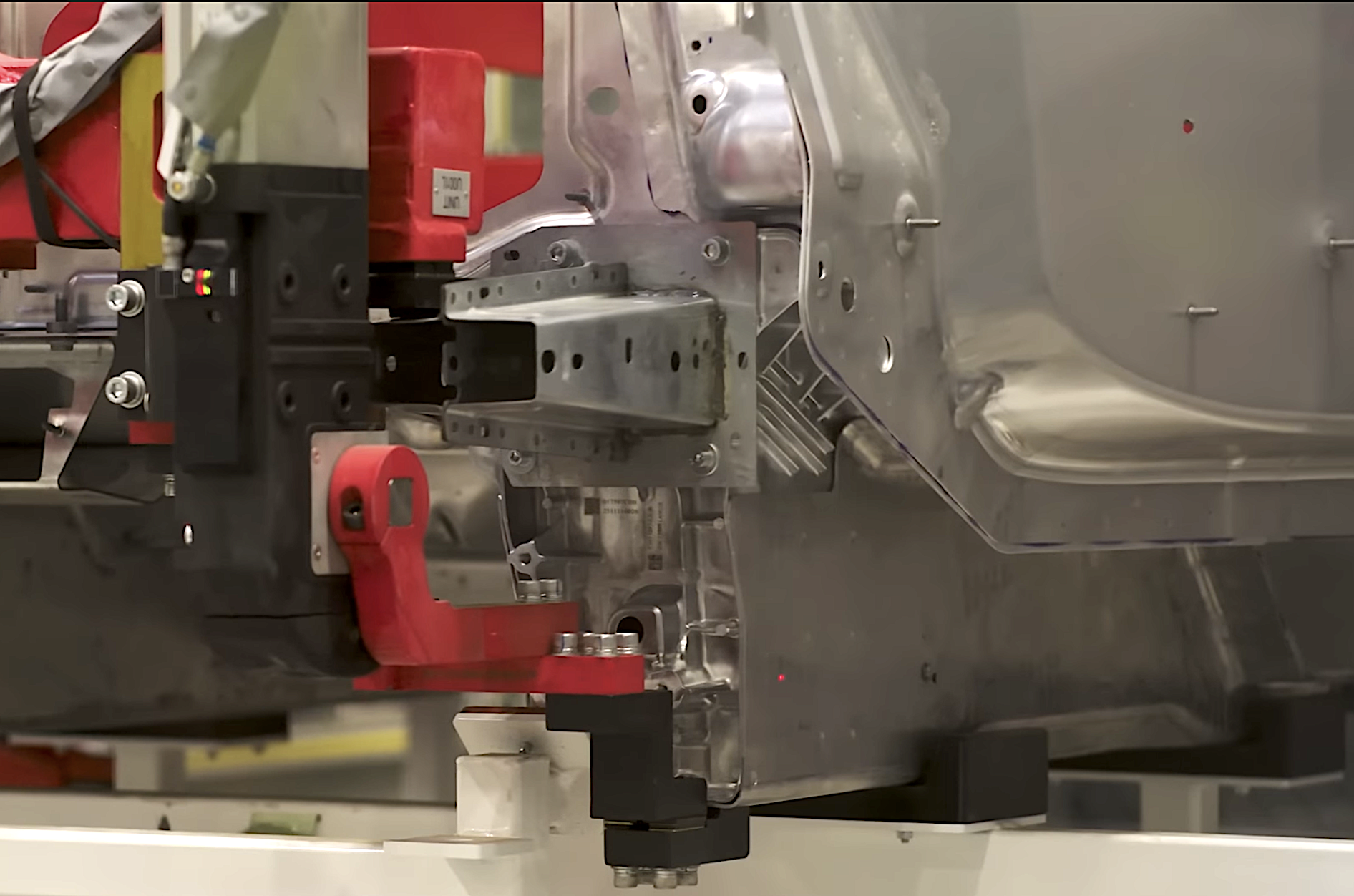
The cab appears to be primarily made of aluminum sheet, while incorporating high-pressure die castings (presumably aluminum) in both the floor structure and at the top of the A-pillar as a cast node to join the roof structure (Figure 2). In automotive, these are referred to as body structure castings, as they provide selective reinforcement to an area that needs stiffness, strength, and attachment features. Unique to Tesla, there appears to be large X-shaped castings supporting the electric motors on the axles. The A-pillar reinforcement, as well as the under-floor castings, are most likely industry-firsts in the commercial truck market. In addition to castings, an extrusion appears to be used to support the floor (Figure 3), with the profile extending forward to support the front axle and likely the front bumper. The frame rails from the cab to the rear are steel. Typically, steel rails span the distance from rear bumper to front bumper.
Conclusion
With its Sparks giga-factory now in operation, Tesla is working to scale up production to 50,000 trucks per year. With a production size that large, the company clearly aims to be a major player in the electrification of the trucking industry. However, whether it achieves its goal remains to be seen, since the Tesla Semi 2.0 still needs to prove it’s up to the 1-million-mile lifespan and beyond in order to capture resale value that is critical to the total cost of ownership equation for trucking companies. The company is also working to expand its charging network across the U.S. to enable more fleets to use the Semi outside of the few areas with the megawatt charging system. Whether this new electric model meets the needs of the industry, time will tell.
References
- “National Truck Driver Appreciation Week 2023,” American Trucking Associations, September 8, 2023.
- “Freight Transportation,” MIT Climate Portal.
- “Ford Sales Rose 6% in 2025 on Torrid Truck, Hybrid Demand,” Ford HQ, January 6, 2026.
- Halonen, A., “New Extrusion Applications in Commercial Vehicles,” Light Metal Age, April 2023.
- “Tesla Semi: Specs,” Tesla.
- “Tesla Semi Walkaround & Discussion at ACT Expo w/ Dan Priestley” [Video], Munroe Live.
- “Robots Everywhere: The First Look at Tesla’s Giant Semi Factory” [Video], Core Memory, April 2026.
- “Lightweighting Confidence Report,” North American Council on Freight Efficiency.
Andrew Halonen is president of Mayflower Consulting, LLC, a lightweighting consultancy that provides sales, marketing, and market research for high tech clients. Halonen works with castings, extrusions, artificial intelligence, and machine learning. He earned a BS Mechanical Engineering degree from Michigan Tech University. Contact him at: www.lightweighting.co.
Editor’s Note: This article first appeared in the June 2026 issue of Light Metal Age. To receive the current issue, please subscribe.