
By Alton Tabereaux, Contributing Editor.
The Venezuelan aluminum industry was once a regional leader with advanced technology and skilled labor. However, it has seen steep declines over the past decade, with production at its two aluminum smelters being largely curtailed thanks to dramatic power shortages. As a whole, the country has faced a national power crisis for several years, largely due to droughts that have impacted hydroelectric capacity, aging transmission line infrastructure, and alleged corruption. Bringing the country’s aluminum industry back online will require significant investments to address numerous challenges.
Venezuela’s Aluminum Industry
Corporación Venezolana de Guayana (CVG) is Venezuela’s state-owned metals company, which owns and operates the country’s aluminum and steel sectors. CVG’s aluminum operations include two smelters (Figure 1), Aluminio del Caroní (Alcasa) and Industria Venezolana de Aluminio (Venalum), both situated in the Guayana region of Bolívar State. The company also owns the Bauxilum bauxite mine and alumina refinery and the Carbonorca carbon anode plant.
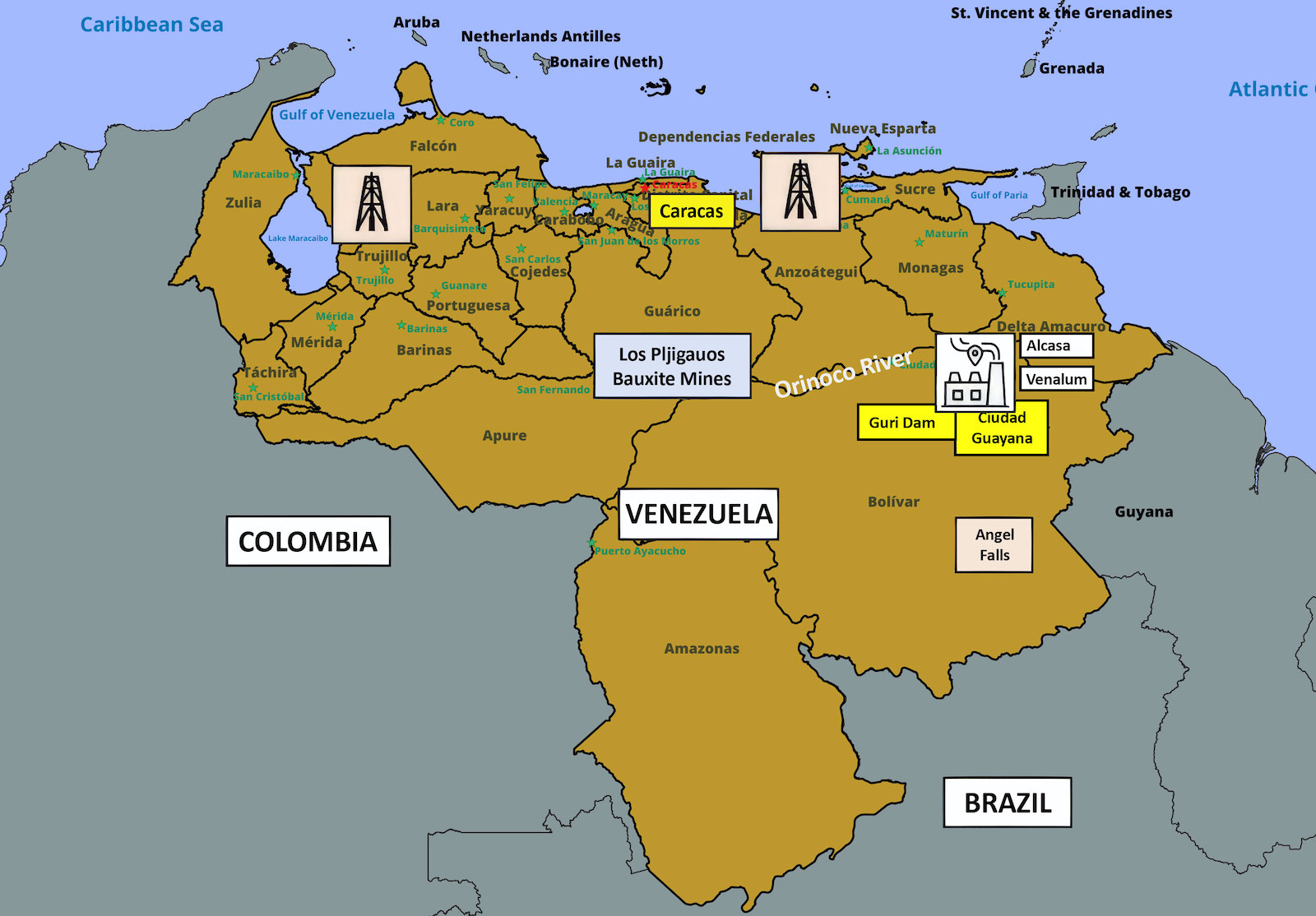
In 2001, Venezuela was the world’s eighth largest bauxite producer, ninth largest alumina producer, and 12th largest primary aluminum manufacturer. At the time, Alcasa produced about 167,950 tonnes, while Venalum produced around 433,350 tonnes — making it Latin America’s largest facility.
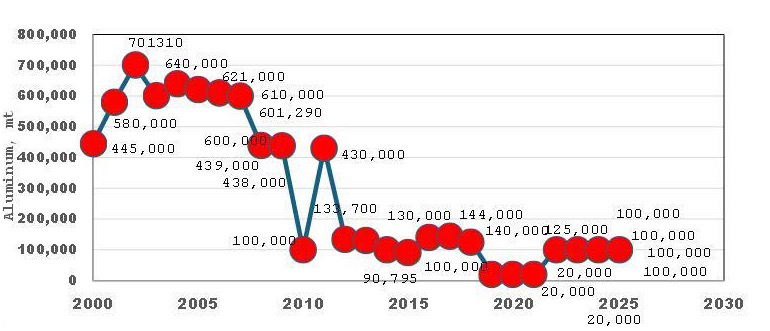
Between 2001 and 2008, Venezuela’s annual production of primary aluminum averaged approximately 600,000 tonnes, which then began to show a sharp decline (Figure 2). Currently, the Alcasa smelter has been shut down entirely, while Venalum’s output dropped from a historic 640,000 tonnes to just 100,000 tonnes annually over the last 15 years.
Upstream Operations
Venezuela’s total bauxite reserves and resources are estimated at approximately 3.479 billion tonnes, comprising 1.332 billion tonnes of reserves and 2.147 billion tonnes of resources. Proven bauxite reserves stand at 320 million tonnes, with a reserve base of 350 million tonnes, predominantly located in Bolívar and Amazonas states. The Cedeno area in western Bolívar remains a significant hub for both bauxite distribution and aluminum industry operations within Venezuela.
Bauxilum operates the country’s sole bauxite mine and alumina refinery, with nameplate production capacities of 6 million tonnes of bauxite and 2 million tonnes of alumina per year. However, actual annual bauxite production has recently fallen below 1 million tonnes, with import and export trade remaining negligible. All bauxite production is now allocated exclusively to CVG’s alumina refinery.
Carbonorca produces carbon anodes for aluminum smelters, with the capacity to produce 140,000 tonnes green anodes and 194,000 tonnes baked anodes per year. These anodes are distributed to Alcasa and Venalum, as well as smelters in Canada, the U.S., Egypt, Nigeria, Russia, and Tajikistan.
Alcasa
Located in Puerto Ordáz, Alcasa was founded in 1960 as a joint venture between CVG and Reynolds Metals Company, with each owning 50% of the project at the time. Alcasa then became the first aluminum smelter to operate in Venezuela then on October 14, 1967. Alcoa became a co-owner in 2000 after acquiring Reynolds in 2000, thus inheriting Reynolds’ existing international assets, including its stake in Alcasa, which had been reduced to 8% by that point.
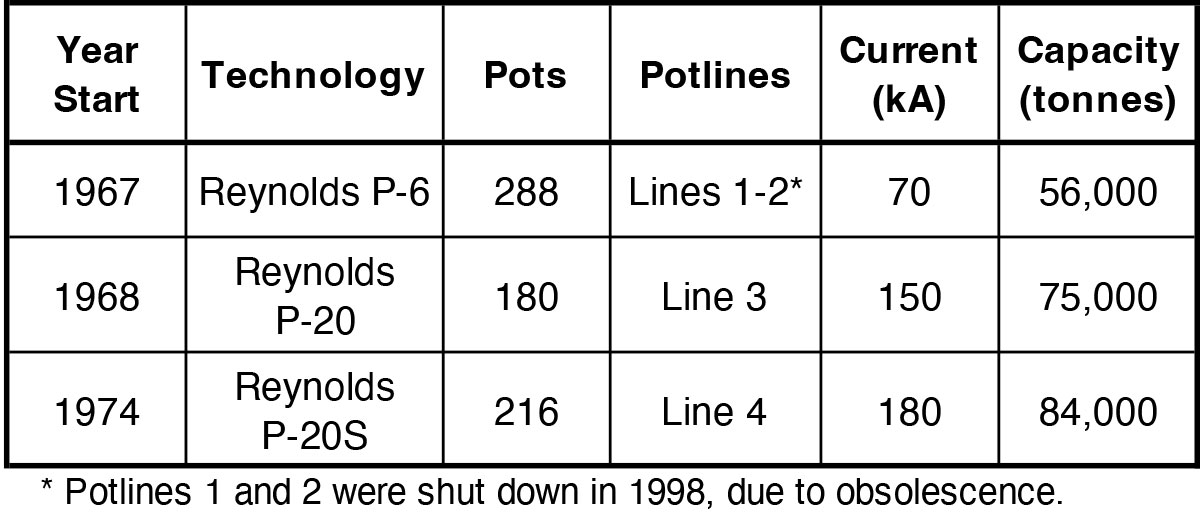
After completing the construction and startup of cells in Potline 1 (Phase 1), the smelter design capacity increased to 10,000 tonnes of primary aluminum. This was followed by the construction and startup of three additional potlines (Table I), bringing its rated production capacity up to 120,000 tonnes per year. The smelter’s electricity consumption has varied over the years, depending on operational capacity, with a potential maximum power demand of over 400 MW.
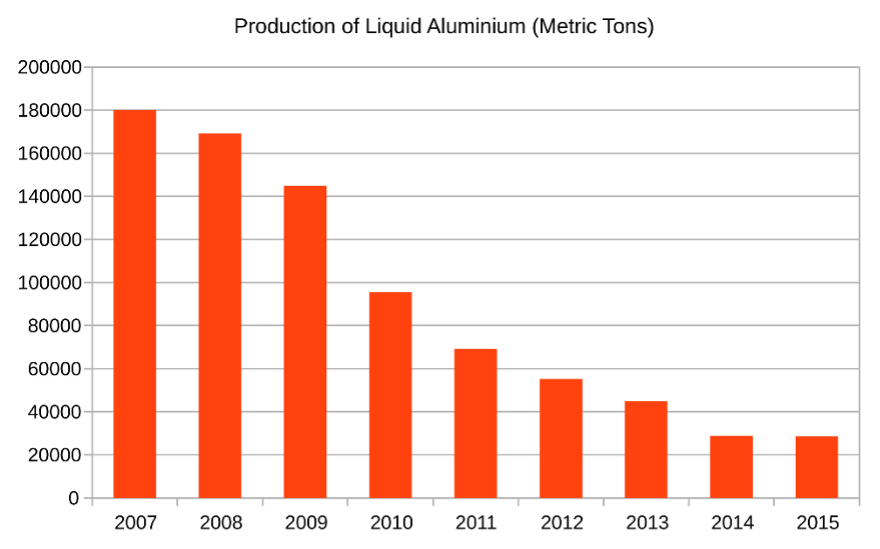
At its peak in 2007, Alcasa operated 597 aluminum cells and produced 180,000 tonnes. Since that time, the smelter has seen a steady annual decline in aluminum output of around 20,000 tonnes per year, bringing production down to just 22,000 tonnes in 2015 (Figure 3). This persistent production decrease is primarily due to a continual decrease in government-supplied electricity.
Alcasa ceased all operations on March 8, 2019, after a nationwide blackout. Previous energy crises, under investment, and earlier shutdowns had already weakened the plant; the blackout ended its remaining production.
Venalum
Located in Puerto Ordaz, Venalum is a joint venture between CVG (80%) and Japanese firms (20%). The smelter began construction in 1975 and was commissioned in 1979. The original setup featured four potlines equipped with 720 Reynolds P-19 pots, operating at 150 kA. This provided an initial output of 70,000 tons. By 1980, the plant had achieved an installed production capacity of 280,000 tonnes per year.
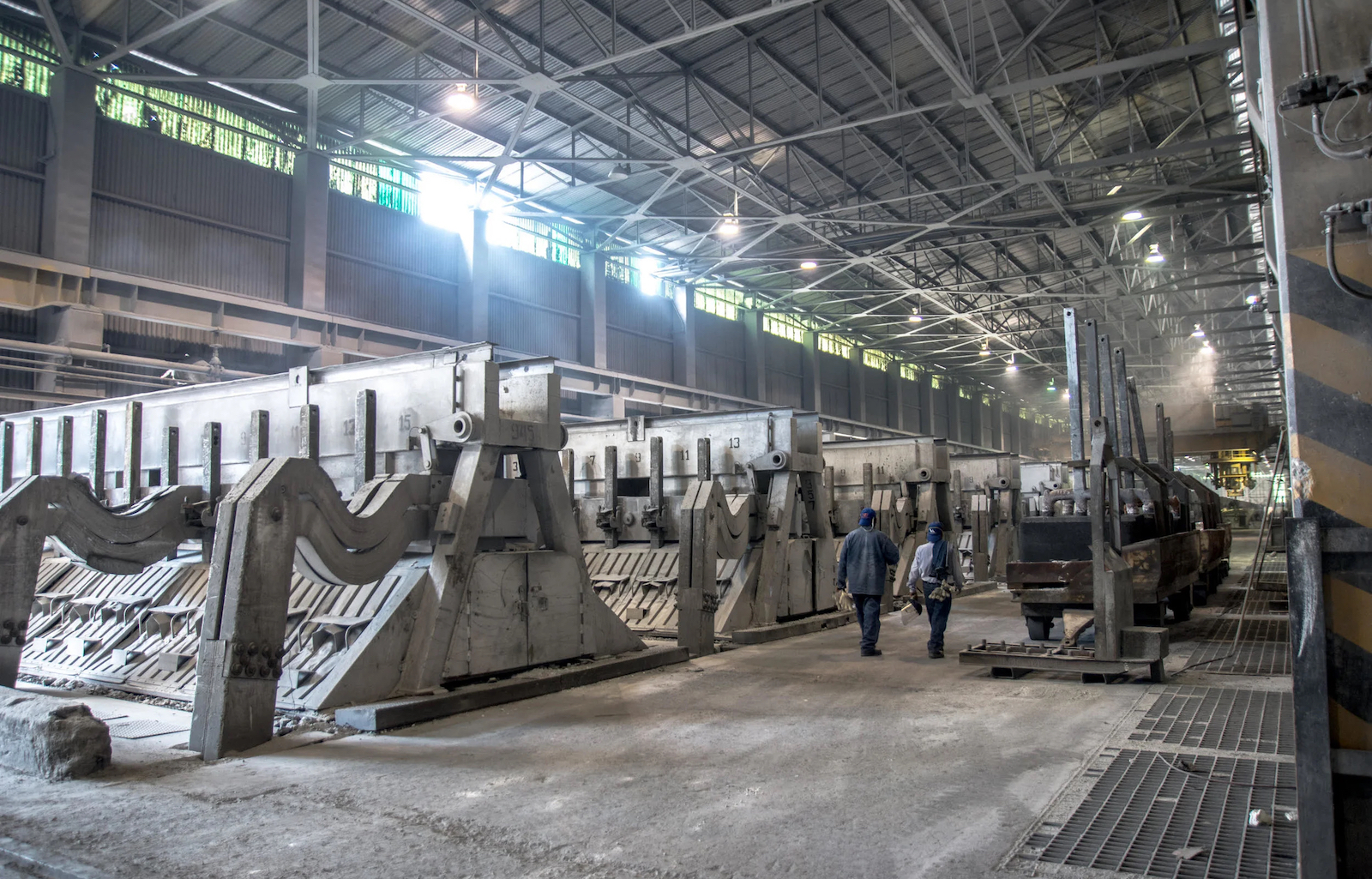
Over the decades, Venalum continued to expand its operation and update its lines and cell technologies (Table II). In 1998, the company installed a fifth potline (Line V), which included 230 kA prebaked anode cells designed by Hydro Aluminium (Figure 4). Line V improved both the energy efficiency and output of the smelter, adding 100,000 tonnes of annual capacity and increasing the plant’s total design capacity to 280,000 tonnes.
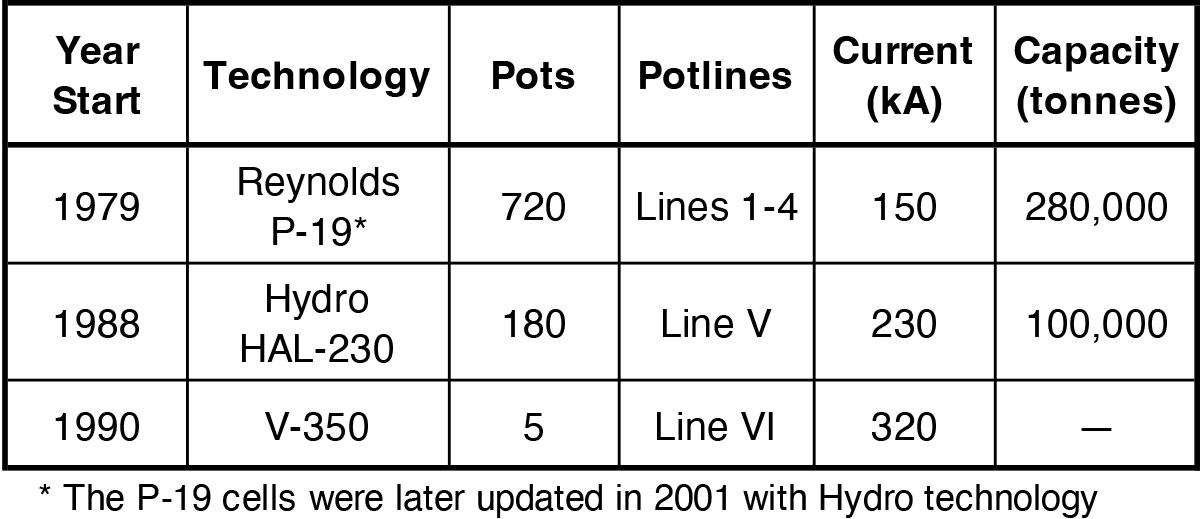
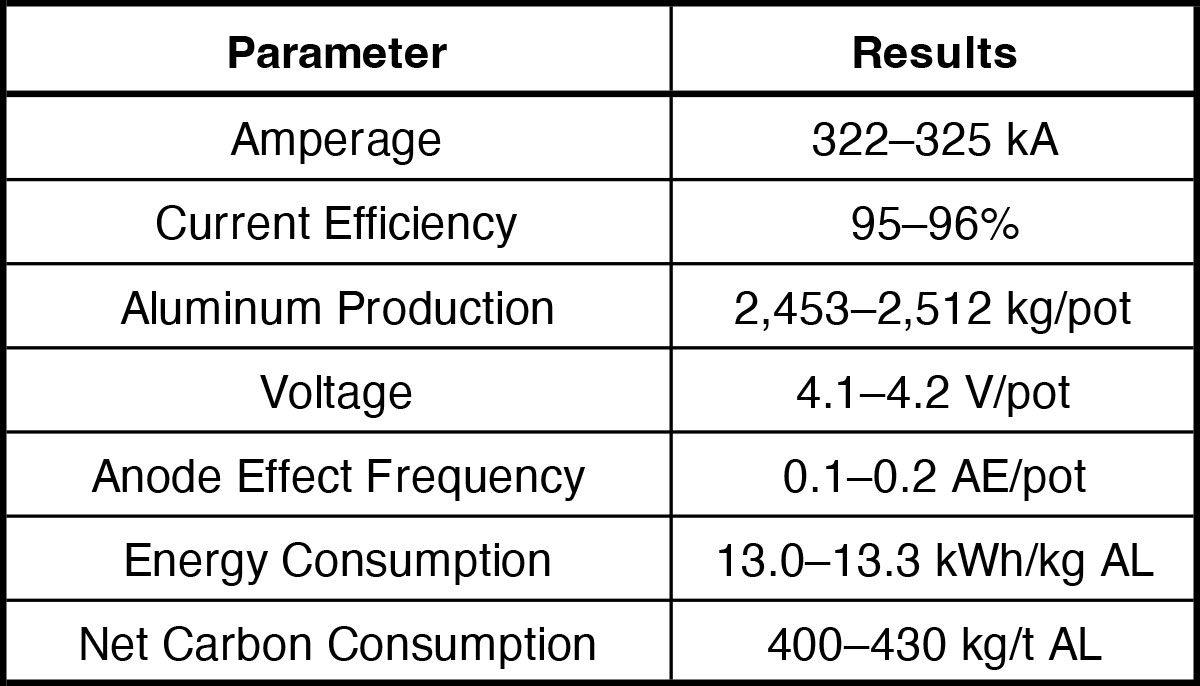
Based on the Hydro technology, Venezuelan engineers developed V-350 cells in 1990. Five experimental V-350 cells were installed in a developmental potline (Line VI) at the Venalum aluminum smelter, using a side-by-side, point-feed design with 36 anodes. The cells were launched as a research effort to achieve higher amperages (320–350 kA) and were proven to operate at 350 kA with high efficiency (Table III).1 These were the first reduction cells in the world to function above 300 kA.
In addition to installing Lines V and VI, Venalum upgraded its original four P-19 potlines in 2001, further enhancing their performance using Hydro technology. Thus, the smelter was able to reach an annual installed production capacity of 430,000 tonnes from then onward — making it the country’s largest primary aluminum producer.
Over the past 15 years, output at Venalum has continued to drop. Following a week-long national blackout in March 2019, the smelter was largely shut down, when the remaining 59 operating pots froze. Attempts to restart production only brought 20% of the plant back online, as of 2021. Venalum currently remains Venezuela’s sole primary aluminum smelter, producing less than 100,000 metric tons annually — far below its nameplate capacity.
Electricity Crisis
Venezuela’s power grid was once regarded as a benchmark within Latin America, largely thanks to the Simón Bolívar Hydroelectric Plant, also known as the Guri Dam. Located on the Caroni River, phase one of the dam began construction in 1963 and was completed in 1969, providing 1,750 MW. With growing demand in the region, all of the planned phases of construction were completed by 1986. This brought the total projected hydroelectric capacity to 10,300 MW, making the Guri Dam one of the largest in the world.
In total, Venezuela has six hydroelectric power plants, accounting for 64% of its power generation in 2021, with the Guri Dam being the largest provider. The country makes up the remainder of its power supply through natural gas (25%) and petroleum (11%).
In 2007, the Venezuelan government nationalized the electrical sector through the formation of state-owned Corporación Eléctrica Nacional, S.A. (Corpoelec), which merged ten state-owned and six private-owned power companies. As a result, Corpoelec manages all of the country’s electricity, while PDVSA oversees oil and gas sectors.
Venezuela’s energy crisis began in 2009, when the country experienced a prolonged drought affecting its hydroelectric power supply. The Guri Dam was especially hard hit, with the reservoir’s water level dropping to 9 m below optimal by February 2010. Concerned that water levels could drop so low as to cease operation of the hydroelectric plant, the Venezuelan government officially declared an “electrical emergency,” leading to rationing throughout the country. Major industries, including steel and aluminum, were ordered to reduce energy consumption, resulting in reduced capacity. Specifically, the government announced that 400 cells in Venalum and 200 in Alcasa would be shut down to mitigate the potential effects of the drought.4
In addition to the impact of the drought on hydroelectric supply, the country‘s electrical infrastructure had other concerns. In 2008, it was reported that 79% of thermoelectric plants in Venezuela were over 20 years old, resulting in the plants either operating at reduced capacity or being out of service due to technical issues. Furthermore, the high voltage transmission lines that delivered power throughout the country were oversaturated, which caused some to overload. Although the government declared plans to invest US$100 million to upgrade Venezuela’s electrical infrastructure, the fund reportedly went toward projects that were never completed.
From 2010 onward, Venezuela began to have periodic blackouts, with the country experiencing more than 18,000 blackouts in 2017.5 These growing power challenges culminated in a series of major blackouts in 2019, with the first widespread blackout starting on March 7, which lasted at least 96 hours in the capital city of Caracas and longer in other regions of the country, with full power being restored on March 14 — making it the largest blackout in the country’s history. The effect of these blackouts were widespread, causing disruptions to hospitals, water supply systems, and public transportation.
The March 2019 outage also had a significant impact on Venezuela’s metal and mining industries, effectively paralyzing the Alcasa and Venalum aluminum smelters (as well as state-owned SIDOR, the country’s largest steel company). Following the blackouts, Alcasa was permanently closed, while Venalum’s production reduced to less than 100,000 tons annually. According to the U.S. Geological Survey (USGS), aluminum output in Venezuela had declined by 93% in 2019, compared to 2015.6 The primary aluminum operating rate continues to be around 10–20% of nameplate capacity.7
International Sanctions
Venezuela faces challenges far beyond its electrical infrastructure. The country’s ongoing energy crisis contributed to a political and socioeconomic crisis, which has been marked by hyperinflation, crime, disease, and escalating starvation. This ongoing crisis began during the presidency of Hugo Chávez and has reportedly worsened since Nicolás Maduro’s succession as president in 2013. In response to the 2014 and 2017 Venezuelan protests, the U.S. began imposing sanctions on specific Venezuelan individuals and government entities in 2015,8 which was followed by sanctions on its petroleum industry starting in 2017 and gold industry in 2019. Subsequently, a number of other countries around the world have also imposed sanctions, including European Union, Canada, Mexico, Panama, Switzerland, and the U.K.
On January 3, 2026, U.S. forces captured and detained Venezuelan leader Nicolás Maduro. Delcy Rodríguez, the country’s former vice president, is serving as interim leader. It’s uncertain what this means for the future of the country in the long term, though this move has sparked some hope for redevelopment. However, the U.S. Treasury Department has clarified that, for the time being, all foundational sanctions will remain in place until further formal amendments are made.
Reviving Venezuela’s Aluminum Sector
As the geopolitical situation surrounding Venezuela continues to shift, there remains ongoing questions about the country’s ability to resurrect its economy and industrial sectors. Oil may be a key focus for the U.S., however, the resurgence of Venezuela’s once robust aluminum value chain could also benefit North America. According to Wood Mackenzie, this could help to ease the U.S.’s more than 5 million tonne primary aluminum deficit (as of 2025).9 However, successfully reviving Venezuela’s aluminum industry presents significant investment, infrastructure, and technological challenges.
Stabilizing the Guri Dam would involve critical maintenance and repairs, including a refurbishment of the dam’s 20 turbines, modernization of its instrumentation and controls, and dredging operations to clear sediment buildup in the reservoir. Additional electrical projects could involve investments in new and existing hydro and thermal power plants, as well as rehabilitation of the country’s substations and transmission lines.
In addition, US$1.6–2.3 billion would need to be invested across Venezuela’s mining, alumina, and aluminum operations to get primary production back up and running, according to Wood Mackenzie.9 This investment would include US$100–200 million in infrastructure and processing improvements to increase bauxite production to 2 million tonnes per year; US$500–600 million to rehabilitate the digestion, clarification, precipitation, and calcination systems at the alumina refinery (1 million tonnes per year); and US$1–1.5 billion in the Venalum smelter to reline cells, rehabilitate power systems, improve anode production, and make infrastructure and environmental enhancements, bringing capacity up to 460,000 tonnes per year.
“While reviving Venezuela’s aluminum sector presents significant opportunities, it also comes with major challenges,” said Uday Patel, principal analyst at Wood Mackenzie.9 “In the end, it will come down to a trade-off between political and strategic expediency and economics. However, if conditions are met, it could take only two to three years to fully reestablish the aluminum value chain.”
References
- “Industrial Projects,” Protecnica.
- Berrueta, Lenin, “CVG Venalum – Lines VI and VII,” Light Metals 2004, pp. 223–226.
- “Guri Dam,” Encyclopedia Britannica.
- Siverio, Ramsés Ulises, “The Big Blackout of the Venezuelan Aluminium Industry,” Caracas Chronicles, March 14, 2019.
- Rendon, Moises. “Venezuela’s man-made power outage,” Center for Strategic and International Studies, March 14, 2019.
- “2019 Minerals Yearbook: Venezuela,” USGS, April 2024.
- “Overview of Venezuela’s Aluminum Industry Chain,” SMM, January 4, 2026.
- “Venezuela-Related Sanctions,” U.S. Department of State.
- “Reviving Venezuela’s idle aluminium industry will require up to US$2.3B,” Wood Mackenzie, January 20, 2026.
Editor’s Note: This article first appeared in the February 2026 issue of Light Metal Age. To receive the current issue, please subscribe.