
By Kevin Widlic, Editor.
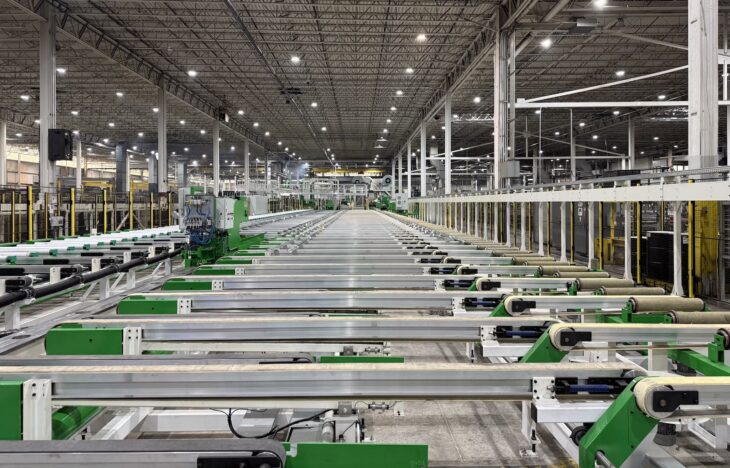
Right in the center of Hydro’s 350,000 sq ft extrusion plant in Georgia is a sign that the aluminum extrusion industry in the U.S. is taking a fresh step forward. It is the facility’s hybrid electric extrusion press, and it is something to see. The new press in Gainesville started operation in February of this year — using a hybrid electric/hydraulic design with electric motors for nearly all press functions — and the event was so important within Hydro that its chief executive took a flight from Oslo to be one of the first visitors to get a look at the new HybrEx press (Figure 1).
“Seeing the nearly all-electric extrusion press up close was impressive,” said Eivind Kallevik, president and CEO of Hydro. “It is the first of its kind in the Hydro system, and a clear example of how we combine technology, productivity, and sustainability. The feedback from operators was equally encouraging: higher efficiency, improved safety conditions, and strong engagement around the ramp-up. We’ll start off with it here, and then we’ll learn from it and see if we can utilize the same type of technology in some of our other sites.”1
Gainesville Operations
The Gainesville plant, some 55 miles northeast of Atlanta, was established as Indalex Aluminum Solutions in 1987 for the sole purpose of providing extrusions to its sister company, Peachtree Doors & Windows. The plant covered 125,000 sq ft, housing one press and one paint line, and working one shift. Its 14 employees served a single customer: Peachtree.
Since that time, the operation has reinvented and adjusted its business while diversifying its customer base. Significant expansions from 1989 to 2001 brought the facility to its current size, and today, the Gainesville plant has five presses, two paint lines, and continuous operations. It employs 358 people.
The plant provides extrusion, fabrication, and finishing services to the building and construction, electrical, and distribution segments, as well as to other key markets in the southeast region of the U.S. The region is a strong market for building and construction products that require thin walls, tight tolerances, and high-quality paint and powder finishes, according to Ralph Westphal, who is vice president and general manager of Hydro Extrusion North America’s South & East Region. He adds that the new press is expected to increase the site’s extrusion capacity to better align with its finishing capacity and supply top quality B&C products into the region.
Highly Efficient Extrusion Press
Demolition of the old press line and site preparation activities began in early 2025. The new press was installed in late 2025, and its first production runs took place in February 2026.
Hydro Extrusion North America’s capital project engineering team oversaw the specification, design, and engineering of the new press line. The team worked closely with SMS group and OMAV to ensure smooth installation. And since the press was a direct replacement of the site’s previous 7-inch, 16 MN press, a new building was not necessary.
Hydro removed the existing 7-inch press to make room for the new press. This will expand the site’s capabilities, according to Bobby Maddox, plant manager of the Gainesville plant, who noted that it should double the productivity of the press it has replaced. He explained that the new press fits the “sweet spot” of product needs for the B&C market, calling the HybrEx technology cutting edge, with his team in Gainesville pioneering the technology in close collaboration with SMS group.
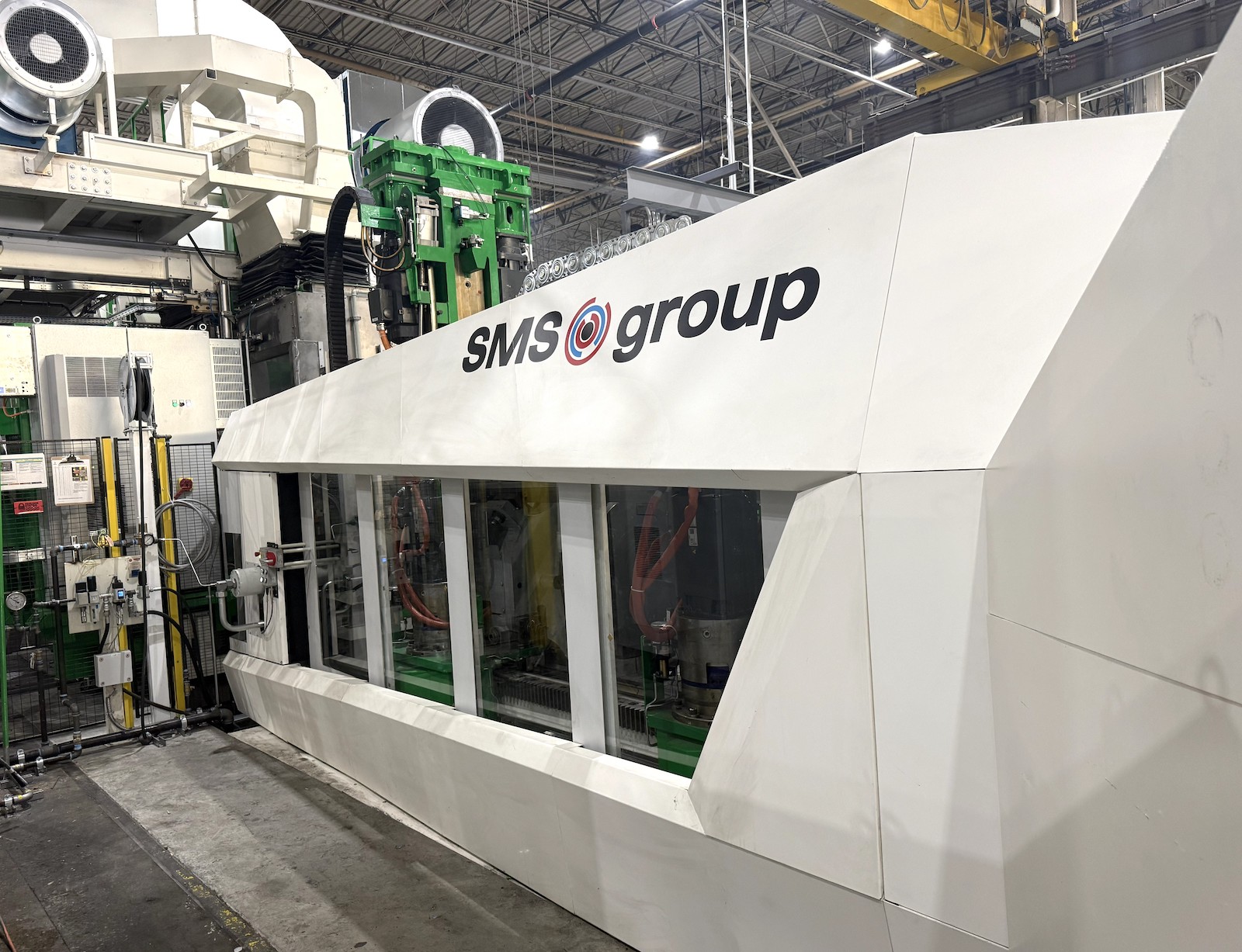
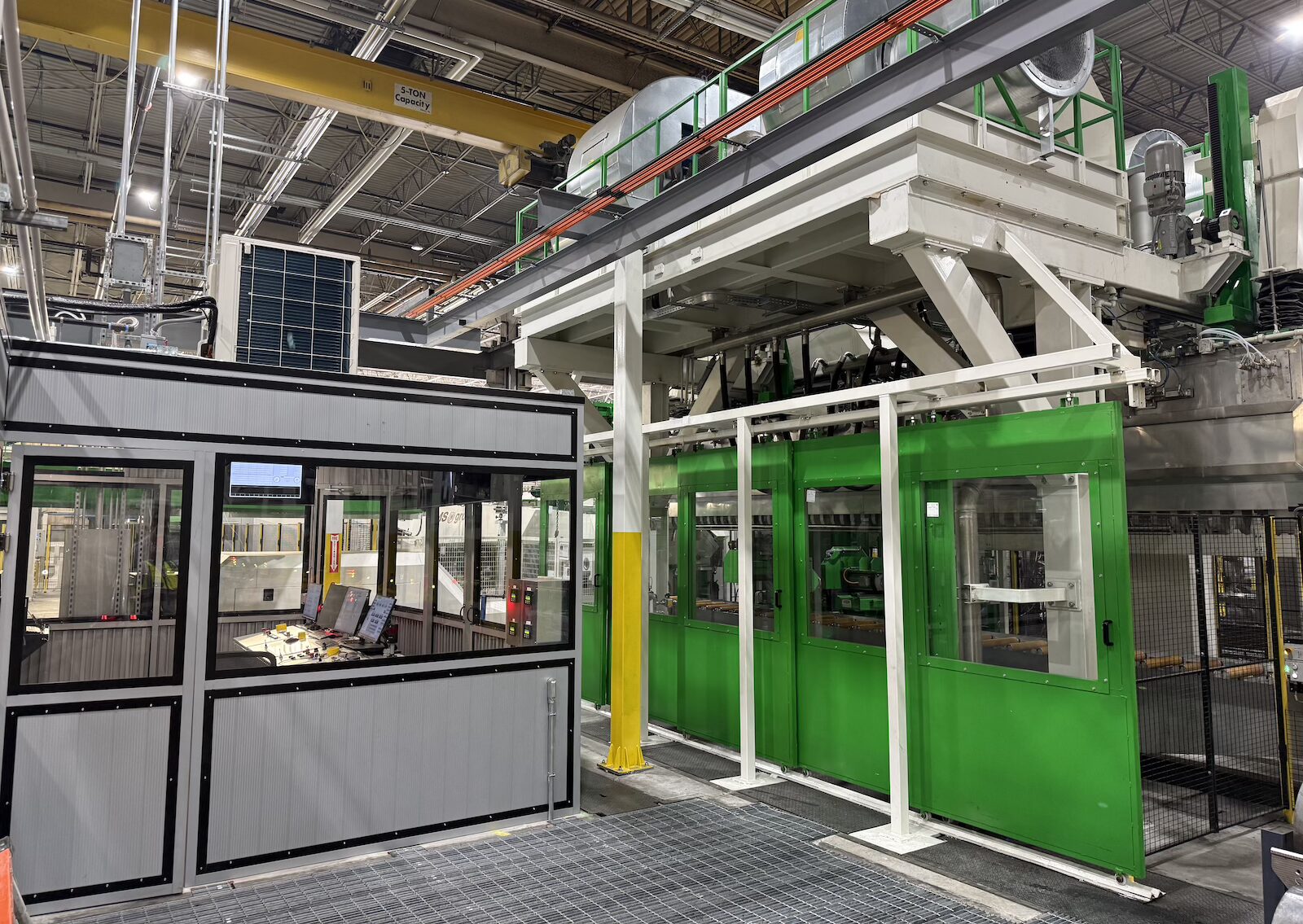
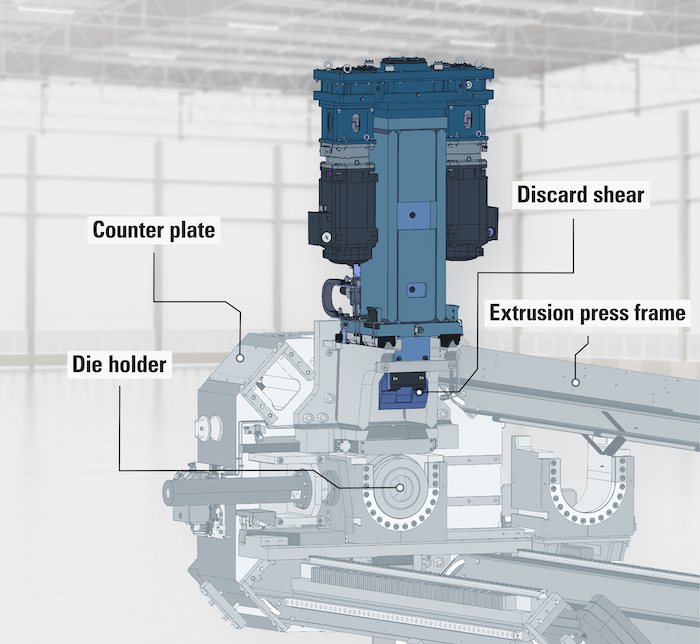
The 8-inch, 25 MN HybrEx electric press and handling system includes a high-efficiency gas furnace, an advanced quench (Figure 2), and the SMS-patented, first-of-its-kind electrical butt shear (Figure 3). The fully electrical butt shear eliminates the need for traditional hydraulic shearing operations, thereby creating an oil-free hot zone, which enhances operational safety and reduces environmental impact. The handling system includes high-performance quenching (air and water), electric pullers, stretching, sawing, and an automatic profile stacker.
Maddox states that Hydro is expecting a 76% decrease in energy consumption and CO2e per ton of aluminum profiles produced, as compared to the previous 7-inch press. As a result, it will be Hydro’s most efficient extrusion press in operation, both operationally and environmentally.
All projects come with challenges, and this one was no different. One of the challenges was related to the U.S. trade environment, which resulted in a wide range of tariffs being applied to the thousands of imported parts and pieces necessary to build the extrusion line. Another was managing the installation of the press line while the Gainesville site operated at full capacity. This necessitated precise coordination between the operations and engineering teams.
Hybrid Design Saves Energy
SMS has communicated that the savings in energy consumption from its HybrEx technology are due primarily to its hybrid drive concept, which was first introduced in an article by former editor Joseph C. Benedyk, published in the April 2014 issue of Light Metal Age.2 Conventional presses use hydraulic main cylinders to generate the extrusion force and hydraulic side cylinders for fast forward and return movements of the main cylinder.
In comparison, the HybrEx press uses high-precision, high-speed electric servo motors to replace these conventional side cylinders. This enables the system to provide rapid advance and retraction of the main ram, with low-friction and wear-resistant linear guides for precise positioning. The hydraulic drive is only used for generating the high forces needed for the extrusion process and discard shearing. As a result, the press reportedly doubles the speed of the forward and back movements of the container, thus reducing dead time by 15-40%, compared to conventional presses (depending on the extrusion parameters).2
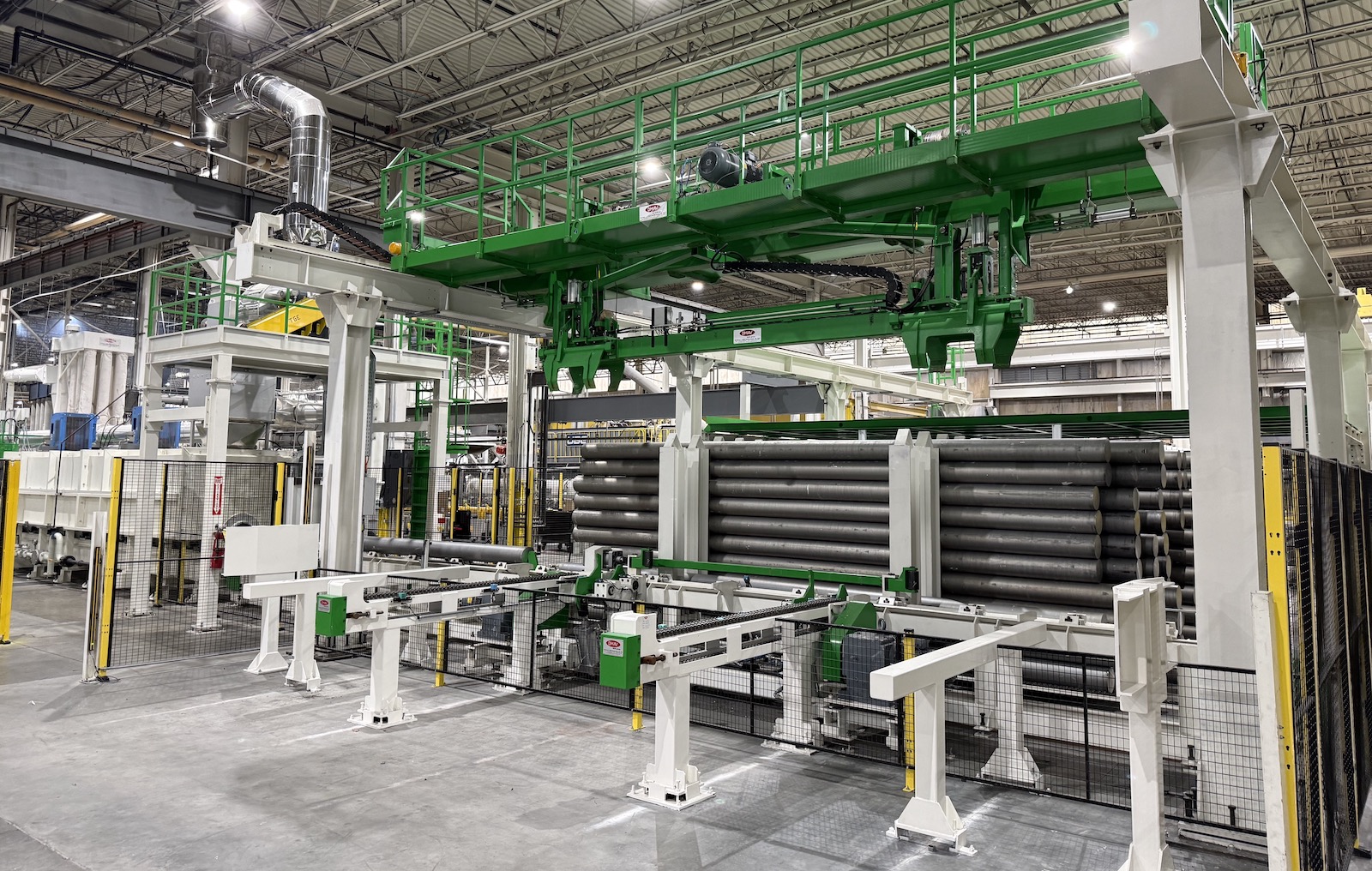
In addition, the press is outfitted with an all-electric billet loader (Figure 4), which uses servo drives to power the loading grippers (including the telescoping action and opening and closing movements).2 As a result of the advanced electrical systems and reduced hydraulic power requirements on this press, the HybrEx press is said to provide significant energy savings in extrusion operations, depending on the alloys extruded, the stem speed, and press design.
Hydro’s Modernization Strategy
Massimo Marinelli, who is OMAV’s chief executive officer, explained that the new press line in Gainesville was engineered to meet the high operational standards of Hydro, adding that improved safety—both for personnel and machinery—was one of the priorities. “This project underscores our longstanding partnership with Hydro,” he said. “By combining SMS group’s technological leadership with OMAV’s automation expertise, we delivered a future-proof solution that meets Hydro’s high standards in efficiency, safety, and sustainability.”
The new HybrEx press installed in Gainesville features a significant reduction in hydraulic system oil usage, as traditional oil tanks and high-temperature cylinders around the hot billet container are no longer required. It also provides a reduction in oil volume, by combining the use of hydraulics to generate the press force and the electrification of the travel paths. This combination of hydraulic and oil quantity reductions brings down energy consumption needs by more than 30% compared to conventional extrusion presses.
Investing in American Manufacturing
Hydro employs more than 5,500 people in the U.S., and operates 21 extrusion plants throughout the country, including Gainesville. These plants are organized within the business unit Hydro Extrusion North America.
Westphal says the business unit is committed to investing in its operations and in supporting American manufacturing, and that the Gainesville project is aligned with Hydro’s modernization and automation strategy and its overall sustainability efforts. He said, “This investment represents a significant step in our modernization strategy, and we are excited to implement these cutting-edge technologies.”3
References
- “Why a Norwegian firm chose Georgia for an innovative way to produce aluminum,” The Atlanta Journal-Constitution, March 5, 2026.
- “The New and Innovative HybrEx Extrusion Press,” Light Metal Age, August 2014.
- “SMS group delivers high-efficiency HybrEx extrusion line with fully electrical shear to Hydro Gainesville,” SMS group, May 13, 2025.
Kevin Widlic has more than 30 years of experience in the aluminum industry, having worked for Norsk Hydro and the former extrusion company Sapa. In addition to extrusion, he has worked as a communications officer for Hydro’s upstream primary and secondary aluminum operations, as well as its rolled products business, which was later spun off. Widlic also authored the book, Our Way: From Karmøy to Kalamazoo, on the history of Hydro Extrusion and edited technical works such as the company’s Extrusion Design Manual and Adhesive Bonding of Aluminium handbook.
Editor’s Note: This article first appeared in the April 2026 issue of Light Metal Age. To receive the current issue, please subscribe.