
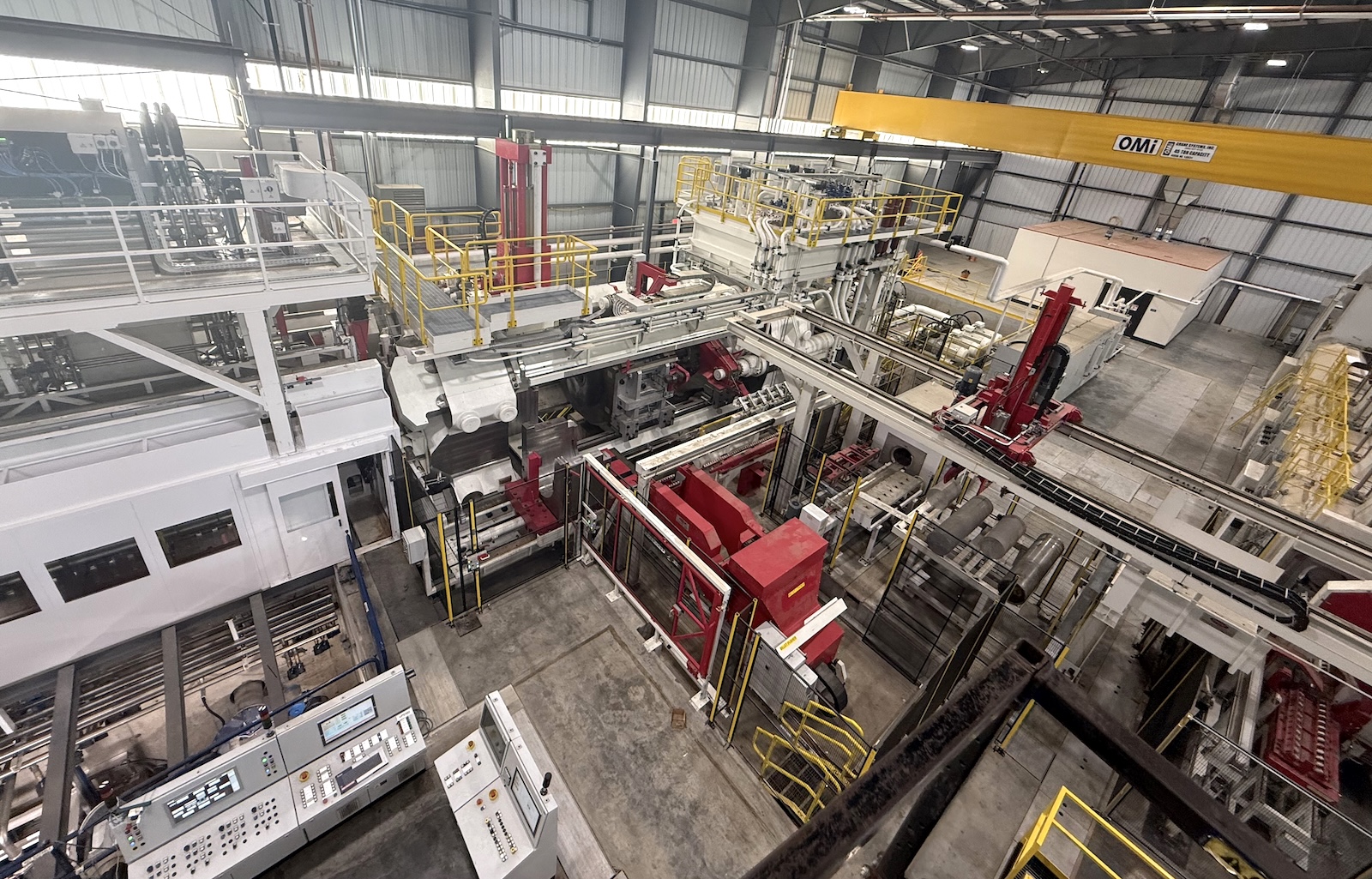
Taber Extrusions, LLC completed the installation and startup of its new 16 inch, 10,000 ton press, which expands the company’s capabilities in the production of large, complex profiles for the defense and aerospace sectors (Figure 1). Capable of producing both hard and soft alloys, the new press enables the company to meet demand for wide aluminum profiles and structural shapes. Such profiles benefit the defense, aerospace, and other markets by providing an excellent strength-to-weight ratio and part consolidation, which improves performance and streamlines production. In addition, the new press reduces reliance on imports by strengthening domestic supply chains.
Company Profile
Taber Extrusions was founded in 1973, when the Taber family acquired an aluminum extrusion plant in Russellville, AR, from Dow Chemical (which had originally built the plant in 1970). At the time the company pioneered a process for extruding rectangular billet into solid profiles up to 31 inches wide or hollows up to 29 inches wide—largely used for military applications. In 1976, National Material Company L.P. (NMLP) purchased the company.
The company expanded in 1995, with the purchase of an extrusion facility in Gulfport, MS, which housed a casthouse and two additional presses. The company modernized the Gulfport casthouse in 2017, and acquired micro-extrusion capabilities from Lou-Rich, Inc. in 2018, which were installed at the Russellville site. Micro-extrusions are produced on a small press with a circle size of 3 inches or less and a weight per foot of .008 up to .5 lbs.
Fabrication capabilities were added to the Russellville facility in 2014, which housed the company’s large 8,600 MT press with three container sizes (a container for the extrusion of 28 x 10 inch rectangular billet, as well as 16 inch and 20 inch containers for round billet). The fabrication area has been expanded several times since it was constructed, with the addition of B&O B-800 series and Marvel band saws for precision cutting, horizontal and vertical machining centers, and a Zeiss coordinate measuring machine (CMM) for quality control.
In 2020, Taber added friction stir welding (FSW) capabilities. In this solid-state process, a tool generates heat through friction, mixing and forging the softened metal together under mechanical pressure. It is able to create high quality, strong welds with low levels of distortion. Taber’s FSW machine enables simultaneous, two-sided welding of double-wall extrusions up to 32 inches wide, 6.25 inches tall, and 65 ft long and single-sided welding of profiles of up to 31 inches wide and 65 ft long in a single stroke.
To this day, the company continues to extrude billet in a wide range of alloys and sizes, including for the same military program that launched the company, which remains one of its biggest customers. However, Taber has diversified its markets since its inception to include aerospace, automotive, marine, and sporting goods, among many others. For these markets, the company supplies cast and extruded products in a variety of soft and hard alloys, along with value-added services, such as FSW and machining.
Addressing Market Demand
The decision to invest in the new extrusion press took several years and included a detailed market analysis, which highlighted an expected shift in market demand and the need for modern large-profile extrusion capacity in North America. Chuck Stout, president of Taber Extrusions, noted that business is currently down for Taber, largely due to metal pricing, which is at historic highs. This has a dampening effect on sales, with customers purchasing only what they need for specific projects, because they don’t want to carry that metal.
However, Taber has recently started seeing a lot of activity on the quoting side, with defense, aerospace, and other customers asking for pricing on certain profiles, volumes, and so on. “Usually when you see that activity pick up, it means that there’s either additional volume activity out there or new projects coming on,” said Stout. “Or on the defense side of things, working with the government, funding is always cyclical. Typically, more quoting means that some funding has been released for a project.”
This indicates that the market is going to turn around, which requires a rapid response to the sudden increase in demand. “When the market turns and suddenly there’s a lot of demand, customers will be like, ‘Okay, we need it, and we need it now.’ But there’s no inventory in the process to give you any kind of ramp up,” Stout said. “If you go back during the COVID years, you had the downturn, then you had the quick demand shift. When demand came back, the lead times were unsustainably long, just because it couldn’t be produced fast enough. That was across the market, especially on the large profiles.”
Another aspect that led to the installation of the new press was the lack of modernized capacity for large profiles in the U.S. “What our market analysis showed is that in the aerospace and defense market specifically, the industry didn’t just need more capacity in the larger profile range, but it actually needed better capability,” said Stout. “If you look at the large presses that are used in aerospace and in defense, especially in North America, they’re very, very old. Most of the big presses that are pushing hard alloy go back to World War II. There was a need for enhanced capabilities and that’s really a big driver on how we designed this press line.”
Taber also had a need to simply enhance its own capacity. The company’s existing 8,400 ton press in Russellville has the ability to produce some big profiles, thanks to its rectangular billet. However, it is limited in capacity due to it utilizing technology that is more than 50 years old. The company has plans to refurbish its 8,400 ton press with new hydraulics, electricals, and control systems (similar to the project the company completed on its 3,000 ton press in Gulfport a couple of years ago). However, the new 10,000 ton press provides Taber with the capabilities and advanced technology it needs to support customers as the market shifts and continues to grow in future decades.
“We made the decision to make the investment in the new press to make sure we are prepared when the market needs additional capability,” said Stout, “because it gives the designers downstream added capability on what they can ask for as opposed to what can be delivered today off of existing equipment.”
New Press
After completing the market analysis, Taber Extrusions went through extensive process engineering due to the size of the press and its unique design. The company did an thorough evaluation of all the existing suppliers and their capabilities, visiting production lines around the world to observe what currently existed. When Taber presented the specifications for what they wanted to achieve, a few of the suppliers openly admitted they couldn’t do what the extruder was asking. As Stout said, “It kind of narrowed down naturally.”
Ultimately, OMAV and SMS group were selected to supply the extrusion press and everything leading up to it, including the log storage, billet handling, billet saw, log oven, and induction oven. All of the downstream equipment was supplied by Cometal, including the quench, pullers, rollout tables, stretcher, heat treat furnace, and aging oven. The collaboration with these two companies resulted in a unique design for handling large profiles, including some components that were the first of their kind in this press size. All of these components were manufactured at the suppliers’ plants in Italy and Germany (Figure 2).
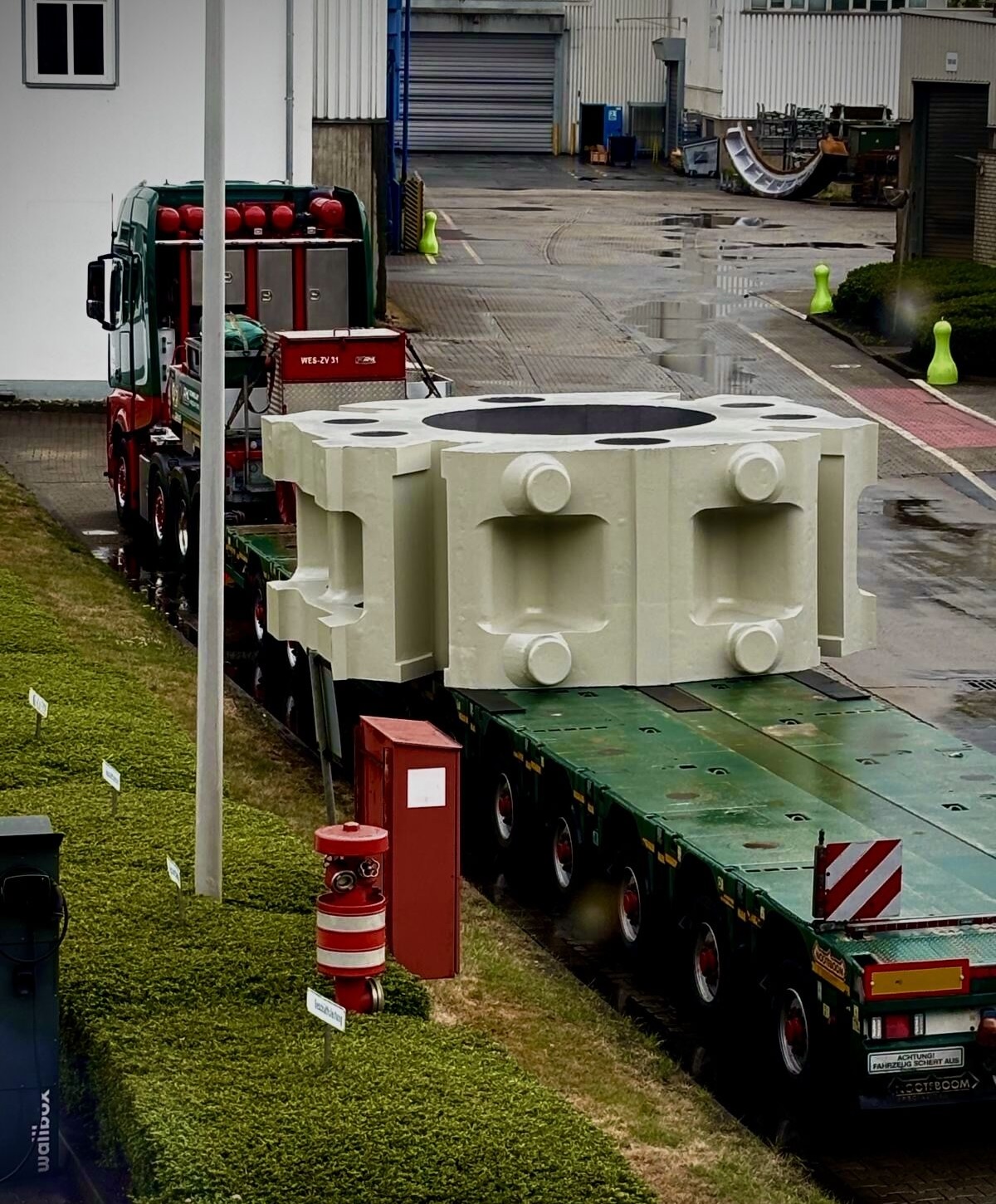
“Working directly with the SMS, OMAV, and Cometal design teams, we came up with what we believed were the best technical solutions for what we were trying to accomplish,” said Stout. “Together, we kind of pushed the envelope on what is possible for this size press, and we’re pretty excited with what we’ve achieved with the collaboration.”
The new press line is housed in an all-new facility, adjacent to the existing facility with a small area that joins the two buildings on one end. An important aspect in the design for Taber was the log heating technology, since the company wanted to be able to taper heat its billets. It was a challenge to find a supplier due to the size of the log being heated. However, the induction heater from IAS, part of SMS group, met the extruder’s requirements. The log is cut on demand, then heated in a gas log heater, which brings the log up to a certain temperature, followed by final heating in the electric induction oven. This process enables a more consistent temperature on the exit of the die during extrusion, which provides a number of quality and production benefits.
The 16 inch, front-loading press features some unique elements. Instead of riding on brass the way most presses do, this is the first press of its size to have linear guide bearings. This helps to maintain tight alignment control, which ensures high quality and efficiency, while also reducing maintenance and upkeep requirements. In addition, the press features hydraulic cylinders that help with the first push coming out the die, which means that operators don’t need to use pry bars to adjust the die in the press, as seen in some older presses.
Following extrusion, the line features a double puller system with a flying cut saw combined with an advanced quench from Cometal. The double puller is able to reach up to the throat of the press and pull the profiles through the quench. The air/water quench features an advanced control system, which is able to adjust to the needs of the complex, asymmetrical profiles that Taber often produces. The quench is not only able to control the water spray and quantity, but also the direction of the water, whether from the top, bottom, or sides. In addition, the quench comes with modeling software that allows the extruder to model how the profile is cooled, which improves the precision of the quenching process.
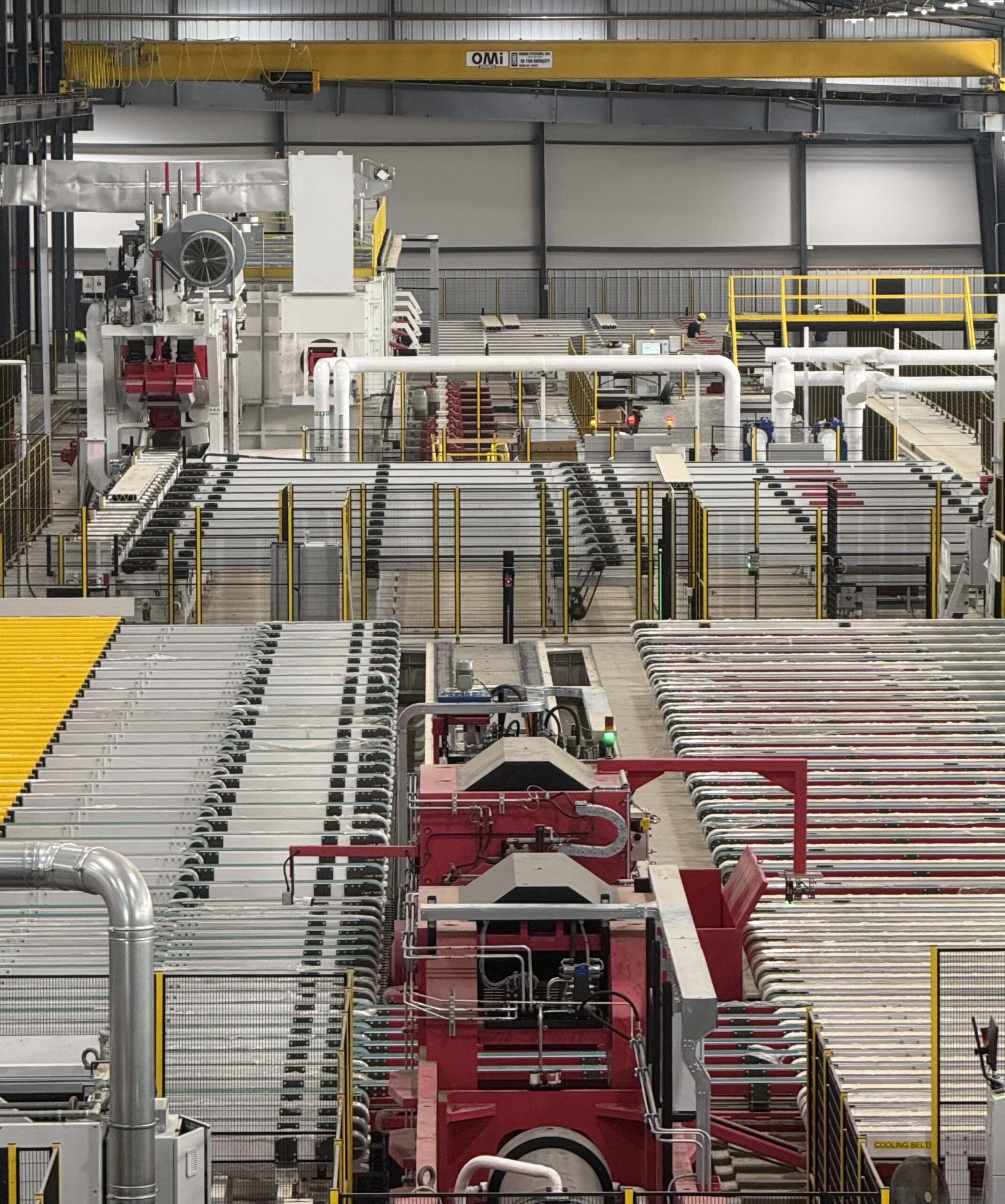
What happens to the profiles next depends on what products are being run. The line has two different roller systems, with soft alloys being run on Kevlar rollers, while hard alloys are run on stainless steel rollers. Soft alloy profiles are then carried to the 550 ton stretcher (Figure 3). After stretching, soft alloys are carried over to the finishing saw and then the aging ovens, if required by the alloy. Hard alloys go down a shuttle system and are fed into the solution heat treat line, which is electric and allows for tight temperature controls and a reduction in gas usage. After solution heat treatment, the hard alloy profiles are directed back to the infeed of the 550 ton stretcher.
High capacity, infrared die ovens were supplied by Novatec Innovative Solutions. Designed to accommodate large tooling up to 44 inches diameter × 24 inches thick, the system is able to efficiently heat large dies, while maintaining uniform temperature, safe operation, and reliable production performance. The oven design features heavy-duty construction, horizontal travelling lids, and an operator-focused control and safety system.
Taber also has plans to install a new die cleaning system. “We’re currently working with vendors on our die cleaning process,” said Stout, “and we are now on the final design and bidding process for that.”
The entire press line is highly automated and features advanced safety, quality, and environmental features. “From the time that we load the log into the rack to the time that the extrusion gets all the way to the end of the line for packing, the whole process can be run in automatic, semi-automatic, or manual setup,” said Stout. “But at no point does an operator have to physically interface with the material. The entire line is marked off with either safety fencing or a safety curtain. If anyone opens a door or crosses a safety curtain, everything is zoned out so that all of the equipment in that zone stops moving. It is the most safety protected extrusion line that I’ve ever seen in my career.”
Sustainability was also an important element of the design. From the beginning to the end of the line, all of the equipment is outfitted with the latest energy efficient models, from the motors to the variable frequency drive. In addition, the line reduces the use of gas, with only the log oven and aging oven still using gas. All of the other furnaces are electric.
Benefits to Aerospace and Defense
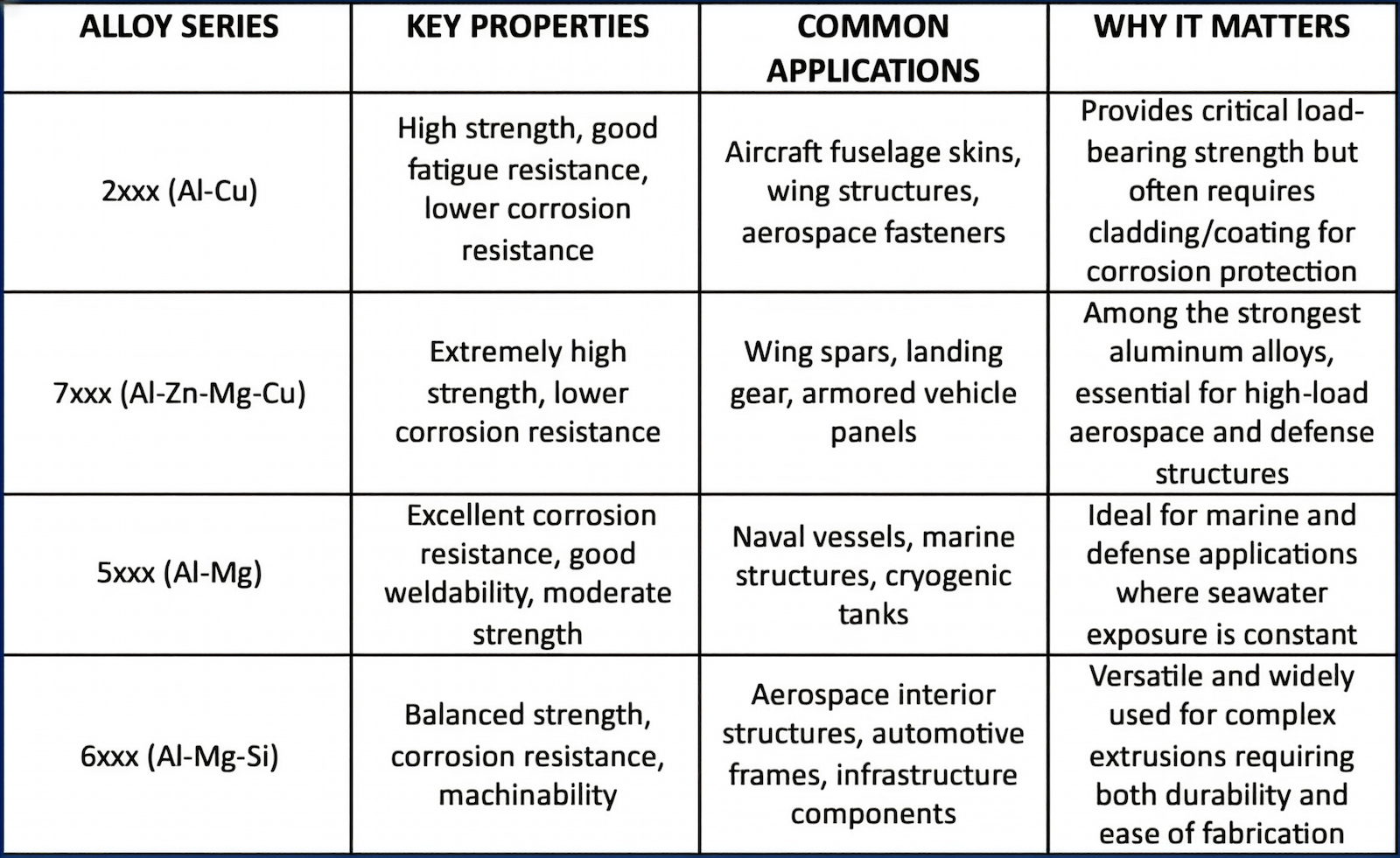
Defense has long been a core of Taber Extrusions’ business, and it remains a market that the company wants to focus on. However, it is also looking to grow the aerospace market, as well as the FSW side of its business. Due to its massive size and its ability to produce both hard and soft alloys (Table I), the new press supports all three of these goals.
The ability to manufacture large, single piece aluminum components up to 24 inches (600 mm) wide provides a number of benefits for both defense and aerospace OEMs—most notably in terms of parts reduction. Traditionally, OEMs have had to rely on the use of multiple smaller extrusions, which are joined using welds, bolts, or rivets. More joints result in increased weight, while also introducing potential failure points and increased labor costs. The introduction of larger profiles reduces the number of parts required, which addresses these concerns, as they are able to achieve tight tolerances across long spans and thick cross sections.
The new press also offers material versatility. Hard alloys (2xxx and 7xxx series) offer the significant strength needed for both military vehicles and aerospace structures, including armored vehicle panels, wing structures, landing gear, and other applications. Hard alloy extrusions are able to provide the tensile strength required for applications that are submitted to decades of vibration, cyclic loading, and temperature extremes. Typically, alloys like 7075 and 7050 are selected for their high yield strength, while 2xxx series alloys are selected for their fatigue resistance.
A challenge in the production of hard alloys is that they tend to show resistance during extrusion, resulting in high flow stress. As a result, a high pressure is needed to extrude these alloys without tearing or surface defects. Fortunately, the new press is large enough and has enough force able to provide the pressure required to produce these alloys with a refined grain structure for excellent structural integrity.
Soft alloys (5xxx and 6xxx series) are often selected for their corrosion resistance and weldability. Combined with the ability to produce large profile sizes, the soft alloys (typically 6xxx) also benefit Taber’s FSW business, which provides design benefits for aerospace, rail, automotive, marine, electronics, and general products (such as energy, construction, and medical devices). Recent FSW projects taken on by Taber include military applications, ramps, and bridges (particularly, vertical-lift bridges, which lift to allow ships to pass).
“We invested in friction stir welding a few years back, and it takes a lot of development work to get into that market,” said Stout. “We are now starting to see the fruits of our labor. That market is taking off to the point where we’re running one full shift, and we’ve recently added a second shift, so that we can ramp up our production. Next year, our goal is to add a third shift to that process.”
Editor’s Note: This article first appeared in the October 2026 issue of Light Metal Age. To receive the current issue, please subscribe.