
By Lynn Brown, Long Point Associates.
While climate change — and the associated focus on the Global Warming Potential (GWP) of various materials — has recently taken a back seat in Washington, numerous aluminum extrusion users remain focused on reducing their environmental footprint. To support their efforts, the Aluminum Extruders Council (AEC) has recently introduced a tool that makes it easier for extruder members to both quantify and better manage their environmental impact.
It’s important to note that environmental impact can be defined in a vast number of ways, including GHG Protocol Scope 1, 2, or 3 emissions, carbon footprint, greenhouse gases (GHGs), or GWP, not to mention other environmental metrics, like smog generation potential or eutrophication (excessive accumulation of nutrients in water bodies). While other metrics will be commented on, this article will focus on GWP, which is measured in kg of CO2 equivalents (CO2e) per kg of material.
Why Extruders Should Care
Go back in history, say to 2024, and one would see the federal government taking a leading role in encouraging the use of lower-embodied-carbon materials, particularly for the building and construction sector. At the time, numerous demonstration projects were being launched for both buildings and infrastructure, which provided financial incentives for the use of below-average carbon intensity steel and concrete. In fact, those architects and builders who were not using materials with at least 20% (or even 40%) below “industry average” would not have access to preferential funding. While steel and concrete were the initial focus of these programs, it was clear that aluminum — the third most significant carbon contributor to construction — was clearly on the federal radar screen and was likely to be on the next iteration of the carbon naughty list.
But that was then; this is now — and the federal government has significantly pulled back on environmental initiatives.
Outside of the federal level, however, the focus on environmental initiatives has not regressed that much. In fact, interest in carbon reduction continues to advance and is being led primarily by the architectural and construction community. Why? Because that’s where the carbon is.
According to the American Institute of Architects (AIA), “The embodied carbon of concrete, steel, and aluminum alone accounts for 22.7% of global CO2 emissions… most from buildings and infrastructure construction.” That percentage doesn’t include the CO2 emissions from heating, cooling, or lighting those buildings, it only represents putting steel and aluminum in the buildings.
Therefore, to reduce GWP in the building and construction sector, the embodied carbon of construction materials needs to be addressed. According to Canadian Architect, about 7% of the construction carbon load comes from aluminum, which puts it behind concrete (~50%) and steel (~35%), but still makes aluminum a significant contributor and a target for reduction.
In the U.S., this challenge of reducing the impact of materials in construction is being addressed in a couple of ways. First, LEED v5 was rolled out in 2025. LEED is the U.S. Green Building Council’s program for recognizing buildings leading in environmental considerations and is a prerequisite for many municipal or governmental buildings. V5 makes embodied carbon reporting a prerequisite for any LEED certification.
Also, for the first time LEED V5 awards points for using materials with embodied carbon that falls below a baseline amount—either an industry average environmental product declaration (EPD), or the same product’s prior EPD. Specifically, points are awarded for a material with an embodied carbon 20% below baseline, and even more points for a material 40% below baseline. Prior versions of LEED offered less points for using materials with a published EPD and/or materials with specified recycled content. Note also that these points apply not only to curtain wall, windows, and doors, but also to interior elements, like office furniture and moveable partitions.
Second, state and local governments are putting “buy clean” policies into place beyond federal mandates. Several examples are as follows:
- As of January 1, 2024, Colorado’s Buy Clean Colorado act requires that select materials used in any public project valued at over $500,000 demonstrate a GWP below the level set by the state architect. Initially this only applied to asphalt, concrete, steel, and glass, but the direction is clear: product specific EPDs are required.
- As of July 1, 2024, CALGreen requires carbon footprint data for materials used in state-funded projects, including schools.
- The 2024 International Green Construction Code (IGCC) and ASHRAE 189.1 also calls for product-specific EPDS; the IGCC is currently used by 13 states, as well as Washington, DC.
- On July 1, 2025, Boston established their NET Zero Carbon Zoning policy, which mandates whole building life cycle assessment (which requires product specific EPDs).
- In March 2026, New Mexico passed the U.S.’s first rebate program for purchasing low-carbon construction materials, including glass and aluminum.
Furthermore, it’s not just the architectural community that is seeking to reduce carbon intensity. Anyone supplying the automotive market can attest to OEMs pushing for reduced embodied carbon in their products. Almost all automotive OEMs have announced carbon neutrality objectives. Ford, Toyota, and Audi, among others, have set 2050 as their target date for neutrality, while Mercedes, Jaguar Land Rover, and General Motors have stated a 2040 target.
Again, the push for lower carbon materials in the automotive sector is accelerating despite the U.S. government reversing their position on tail-pipe emissions and auto fuel economy standards. Given that all significant auto producers are multinational, the U.S. position carries less weight. For example, General Motors, Ford, and Stellantis need to implement carbon reduction technology and lower carbon intensive parts in order to compete effectively in non-U.S. markets.
While not as defined as the auto or architectural markets, an increasing number of other manufacturers, including many in consumer-facing industries are also seeking carbon data as they pursue their own journeys towards carbon neutrality.
The final force driving attention to extruders’ carbon footprint is the full implementation of the Carbon Border Adjustment Mechanism (CBAM) in the EU, as of January 2026. Intended to “put a fair price on carbon emitted during the production of carbon-intensive goods that are entering the EU, and to encourage cleaner industrial production in non-EU countries,” CBAM first came into effect in late 2023, with a “transitional” period that required reporting of the imbedded GHG for select product imports, but without cash payments. That changes in 2026, with payment required for the CO2 generated during the manufacture of carbon intensive products (like aluminum components) that enter the EU. While there remains a lengthy list of details to be sorted out, manufacturers must at least report data for the carbon intensity of their products.
Industry Average EPDs
In 2015, the AEC launched an effort to develop its first Industry Average EPD, which would reflect the environmental performance of U.S. and Canadian extruders. Eleven extruders signed on to provide data. In aggregate, they operated 30 separate manufacturing facilities in the U.S. and Canada, housing over 85 extrusion presses, 22 finishing lines (paint or anodizing), four thermal break lines, and 12 casthouses. Together, they represented just under 40% of total U.S. and Canadian extrusion production for the base data year of 2014, or about 1.7 billion pounds of product shipments. At the time, the driving force came from the construction market (historically the largest consumer of extrusion in North America), as LEED was poised to award points based on the use of materials for which EPDs had been developed.
Under ISO, the “shelf life” of an EPD is limited to five years. Therefore, the study was updated in 2022. A different panel of extruders participated, yielding a slightly more robust data base, representing 31 discrete manufacturing facilities, with approximately 100 extrusion presses, 20 finishing operations, six thermal break lines, and 13 casthouses. Together, they had collective shipments of around 2 billion pounds (38% of annual volume).
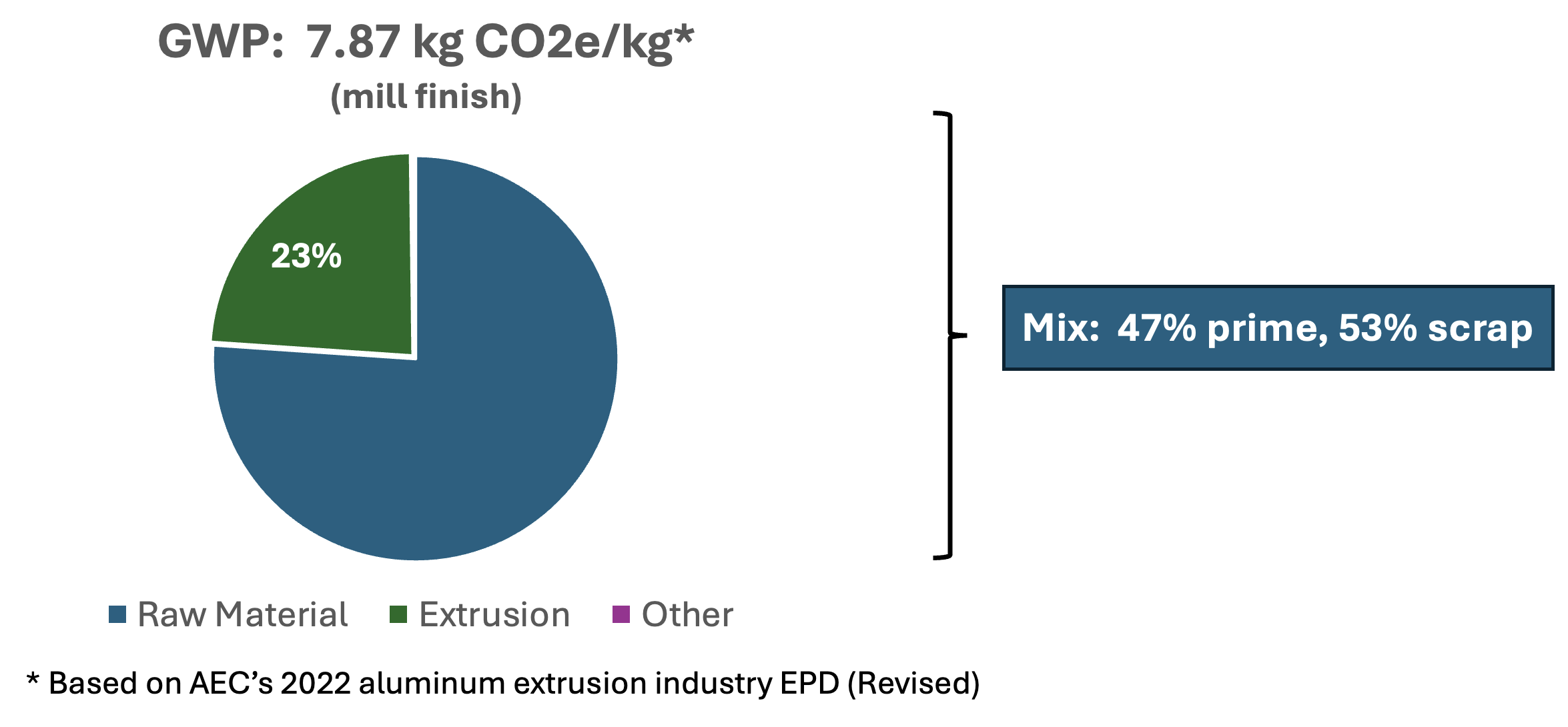
While the exact results differ slightly due to the different participants and time frames, the key conclusions were consistent. The primary driver of GWP for extrusion is the raw material (Figure 1). On average, a kg of mill finish aluminum extrusion contains 7.87 kg CO2e/kg Al. Of that, 77% was derived from the billet utilized in the extrusion process, with less than one quarter being a result of the process itself. (Note that, for the study, this was based on an average billet content of 47% primary metal and 53% recycled aluminum.)
While additional processing of the mill finish extrusion does add to the GWP, the addition is generally not substantial. Anodizing adds about 6% CO2e, while painting (liquid or powder) adds approximately 17% (due to the presence of volatiles). Fabrication (e.g., machining, welding, cutting) was not considered in either the 2015 or 2022 studies.
Industry Average EPDs, like the 2015 and 2022 documents, provide users information about the carbon intensity of extrusions in their various forms, as well as enabling extruders to meet the (then-current) need for documentation necessary to secure LEED points. Most important, however, EPDs suggest strategies that can be used to reduce carbon intensity. Namely, the CO2e derived from billet can be significantly reduced by selecting billet with higher recycled content and/or by specifying billet from smelters with low-carbon energy supply. At present, primary aluminum billet carbon intensity can range from over 18 kg CO2e/kg Al to less than 4 kg CO2e/kg Al, depending on the smelter energy source. Further, increasing the recycled content of billet from the study average (53% to 70%) cuts GWP by almost 25%. Having the EPD data and attendant sensitivity analyses supports a vital dialogue between the extruder and user about the carbon intensity they seek and the various routes to achieve that aspiration.
While the Industry Average EPD is a useful tool, it is a blunt tool. It is, after all, an average. It does not facilitate modeling the impact of actions such as switching to lower carbon billet supply. As a result of these challenges, the Rocky Mountain Institute (RMI) released their Aluminum GHG Reporting Guidance in December 2023. This document, developed with input from major stakeholders (including the AEC), urges aluminum producers to provide environmental data annually, instead of relying on the five-year EPD or the industry average. What RMI is calling for, and various certifications are beginning to require, is current data for the specific facility producing the product and at the product level. (Note that for extruded products the “product” is not a specific SKU, but rather a sequence of processes, e.g., an extruded part that has been painted and fabricated or a mill finish length without additional processing.)
In addition, the producers should provide details about the specific raw material composition. For example, how much recycled material has been used and how much of that material is pre- vs. post-consumer scrap? Primary data (i.e. that specific to materials utilized) should be used in lieu of regional averages or third-party databases. But this remains a challenge, because many billet suppliers are still developing their EPDs.
While most of these requests are “doable,” developing EPDs with annual, facility, and product specific data becomes costly and time consuming using outside consultants, and the results do not lend themselves to easily modeling the impact of raw material alternatives or process changes.
New EPD/PCF Generator
The AEC has developed a tool that allows members to quickly and inexpensively develop their own EPDs or Product Carbon Footprint (PCF) documents. The council selected SCS Global Services as an environmental consultant to develop the tool. Since their founding in 1984, SCS has established themselves as a global leader in the field of sustainability standards and third-party certification, working in the natural resources, built environment, food and agriculture, consumer products, and climate sectors.
While SCS performed the heavy lifting of developing and verifying the tool and assuring compliance with relevant ISO and other standards, the AEC established a “user group” who had worked on EPD initiatives in their member companies. The role of the group was to ensure that the hands-on realities of collecting and assessing extruders’ environmental data were fully considered.
The underlying concept behind the tool was relatively straightforward: participating AEC member extruders upload their company, site, and product specific data onto secure SCS-controlled servers. This data covers the range of an extruder’s processes: extrusion, finishing (paint and/or anodize), thermal enhancement, fabrication, and the casthouse. A “logic check” flags any “illogical” values, which might result from keyboarding errors or incorrect units. Once any issues are resolved, the member can download an EPD or PCF report.
The EPD or PCF is marked “unverified,” which will suffice for internal use and analysis, as well as for some customer discussions. However, in most cases a third-party verified EPD or PCF will be required for external use. That verification can be triggered within the tool and will be carried out by a separate unit of SCS, resulting in the ability to download a verified report in relatively short time.
While the tool concept was straightforward, building the tool to be intuitive and easy to use by other than EPD-professionals was more of a challenge. User ease was addressed by pre-populating environmental data on a wide range of raw materials used in the extrusion process, incorporating a distance-generator to calculate delivery distances for raw material, and providing links to the appropriate energy grid profile in the given zip code.
Despite the functionality designed into the tool, users will still have to go through the process of collecting all the input and output data, which is the most challenging part of the process, especially the first time it’s performed. This involves determining the quantities of various raw materials, energy consumed, waste generated, product shipped — hundreds of individual inputs, covering at least a year. Inevitably, some estimates will need to be made. For example, electrical usage may need to be estimated between the extrusion operations and the paint department, if separate metering is not in place. If suppliers had EPDs available for their specific raw materials, then that data would also need to be input in lieu of the pre-populated data.
Once input and output data is loaded into the system, it will be relatively easy to update. The tool provides for retaining a prior year’s data, then copying and updating for a more recent year. Extruders will be able to easily provide contemporary GWP data for those customers and prospects demanding the data for their own carbon mitigation journey. In addition, the data can be used to explore potential scenarios:
- Looking to upgrade burners for the age oven? Plug in the expected new energy consumption, rerun the generator and see the impact of the improvement on GWP.
- Have a customer considering a specification for low-carbon billet? Plug in the EPD data for that billet and see the resulting EPD for the specific product they are interested in.
- Want to develop a program to substantially reduce a plant’s carbon footprint? Run iterations with different assumptions about operating conditions, equipment efficiency improvements, etc. to develop a roadmap of year-by-year improvements.
Next Steps
Following review and certification of the tool by a third-party expert, the AEC released the tool to an initial group of AEC members in mid-2025. Recently, the first member EPD was submitted for third-party verification. Several other members are also about to submit their EPDs, covering numerous products at multiple sites. These will join over 30 site and product EPDs released by Hydro in 2025, thereby, increasing the library of such documents by around 50%.
Despite its successful launch, developing a tool like this nevertheless reveals the next set of issues that need to be addressed. For example, many of the users are requesting Scope 3 data, which is similar to the tool’s A3 module data for an EPD, but is not the same. Furthermore, an extruder who contracts for renewable energy (e.g., solar or nuclear) and/or buys renewable energy credits (RECs) receives no credit under the current Product Category Rules (PCRs) that dictate how these EPDs are to be conducted. Instead, they are burdened with the characteristics of their local electrical grid.
Another issue is that, while it’s possible to model the benefit of using a low-carbon billet for a particular project, it may be challenging to actually deliver the resultant low-carbon product. It may be manageable for a large, concentrated project where raw material segregation is feasible, but it is likely to be a logistical nightmare for a smaller customer, especially if multiple alloys and sizes are required. Some industries are already using Environmental Attribute Certificates (EACs) to manage this challenge, and the steel industry is considering such an approach. Would EACs (where the benefit of the low-carbon billet is allocated to a given customer, even if the material was used elsewhere) work for extrusion? And what kind of third-party verification is needed to preclude the same benefit being allocated more than once?
As use of the EPD/PCR tool increases, the AEC will certainly uncover the need for additional tweaks. With the current PCRs expiring in 2027 (since, they also have a five year life), there is the opportunity to address several of these issues quickly.
In conclusion, the demand for carbon data and for carbon reduction has not gone away. This new tool makes it easier and much more cost effective for AEC member extruders to both provide the information that customers require and to strategize with those customers on how best to arrive at a mutually beneficial solution.
Editor’s Note: This article first appeared in the April 2026 issue of Light Metal Age. To receive the current issue, please subscribe.