
By Sam Wagstaff, Oculatus Consulting.
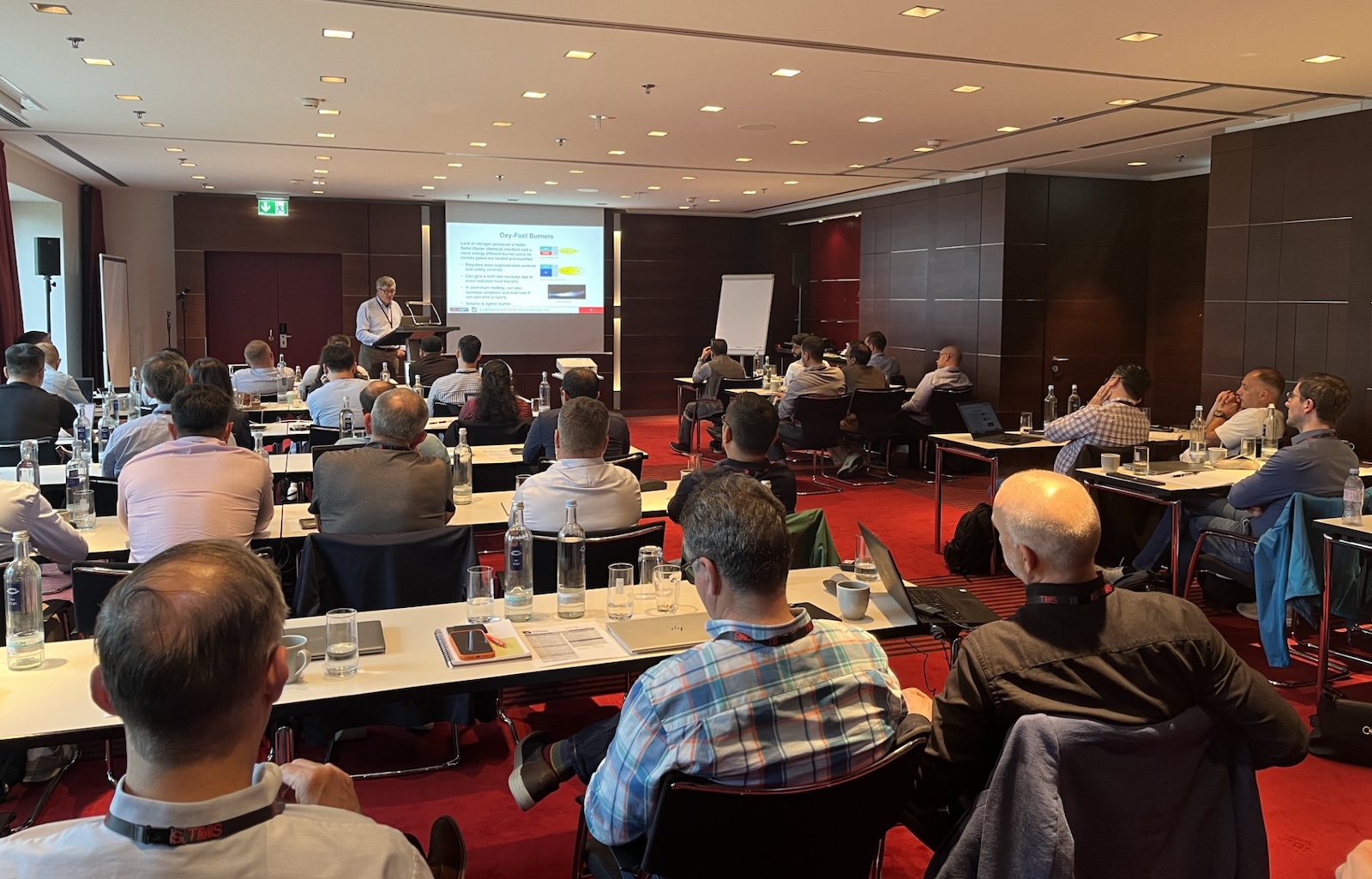
For five days on June 15–19, a meeting room in Düsseldorf, Germany, held an unusual concentration of casthouse knowledge (Figure 1). Forty-one participants—operators, metallurgists, plant engineers, and technology suppliers—gathered for the TMS Aluminum Cast Shop Science and Technology Course, and when their experience was tallied alongside that of the instructors, the room represented 584 years of collective time in aluminum, though some of the attendees had only a few weeks of personal exposure to aluminum production.
The week ranged across the full arc of the casthouse: the economics of the value chain, sustainability and carbon accounting, safety, primary production and impurity control, melt treatment from hydrogen degassing to inclusion measurement, dross and metal recovery, scrap recycling, grain refinement, segregation, hot and cold cracking, and the casting technologies themselves—from billet and slab molds to secondary cooling, starter blocks, and the defect mechanisms that haunt every pit. A number of lectures covering the basics were pre-recordings for the benefit of the attendees. The course included a visit to AluNorf, the largest aluminum rolling mill in the world, where the abstractions of the classroom met slabs measured in meters and tonnages measured in thousands.
The curriculum was built on fundamentals, such as Sieverts’ law and bubble mechanics; the thermodynamics of sodium removal; the difference between solidification shrinkage and thermal contraction; links between grain size, macrosegregation and cracking; and the upstream conduction distance that governs a billet surface. These topics are the first principles of the trade, and the course taught them as a connected system rather than a list of unit operations. A furnace temperature decision reappeared an hour later as a hydrogen problem, then as a dross problem, then as a carbon-accounting problem. That systems view is precisely the kind of holistic understanding the casthouse was built on, and it is the through line that gives the rest of these reflections their weight.
Putting Knowledge to Work
What kept the week from becoming a lecture marathon was that the material did not stay on the slides. Several sessions handed participants a problem and asked them to reason their way through it with the science they had just been given. This is exactly the muscle a casthouse engineer is supposed to develop, and exactly the kind of mental muscle that, as argued hereafter, the industry is at risk of letting atrophy.
One exercise put a metal-supply disruption in front of the room. With supply to the caster constrained, participants had to work backward through the process chain—such as remaining furnace metal and the difficulty of weighing it accurately, recovery rates that vary by alloying addition, scrap composition that can swing widely from batch to batch, and the melt constraint that so often sits upstream of the pit—to diagnose what had gone wrong and decide what to do about it. The point was not to arrive at a single right answer, but to think across the whole system, the way a real disruption forces an operator to.
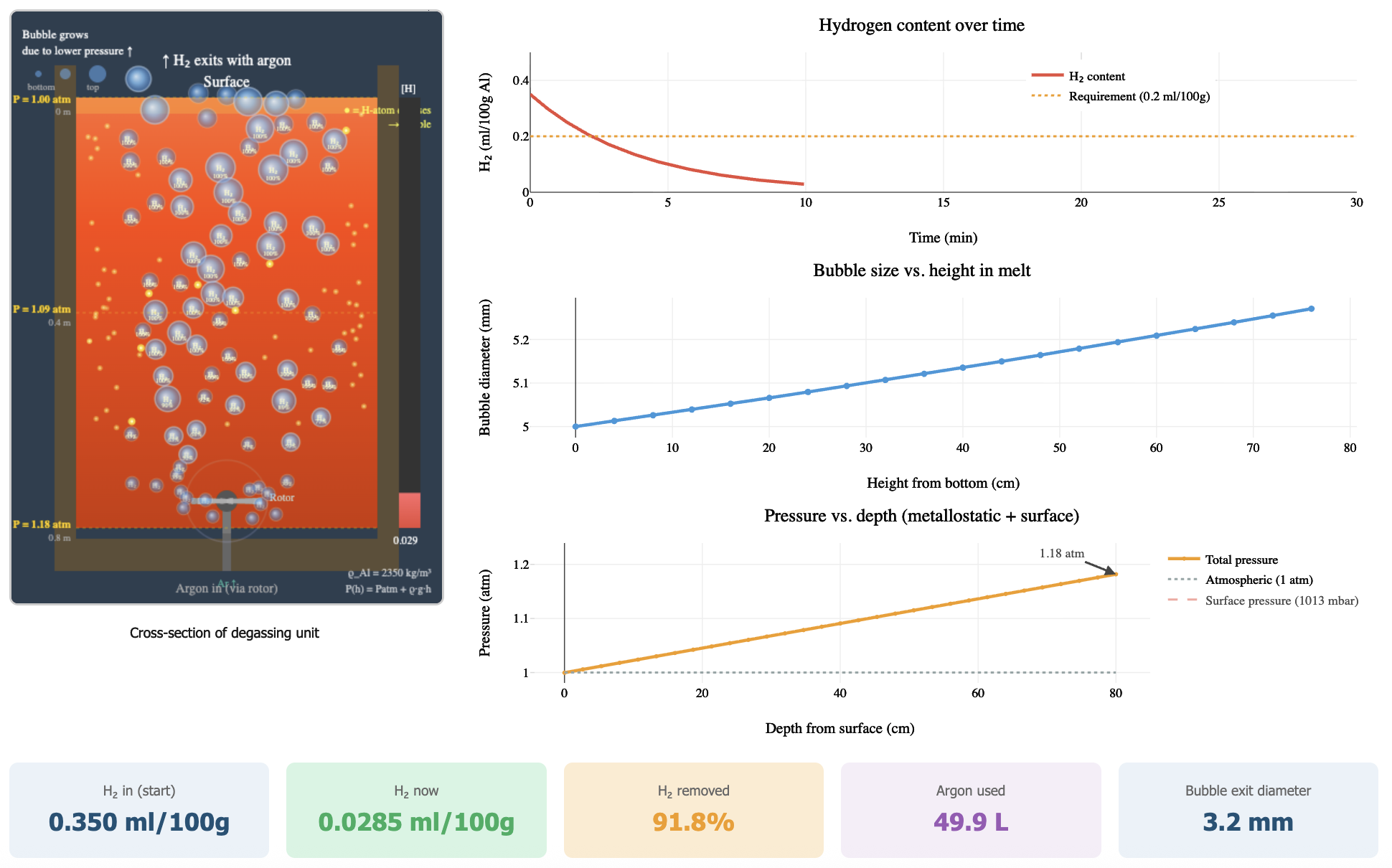
A second activity worked through the fundamentals of a degasser. Using a web application built around Sieverts’ law, participants explored how hydrogen solubility responds to temperature, pressure, and alloy composition (Figure 2). They then reasoned through the mechanics that make an inline unit effective, such as why smaller bubbles matter so much (dropping average bubble diameter from roughly 6 mm to 1 mm triples the interfacial area available for diffusion at constant gas flow) and how rotor speed, gas flow, residence time, and a benchmark of about 150 normal liters of argon per tonne combine to hit a hydrogen target. It is the kind of exercise that turns a degasser from a box on a purchase order into a process the engineer actually understands.
The most ambitious activity assigned each group a casthouse scenario, drawn at random, and asked them to design and audit it. Starting from the gap between a plant’s theoretical maximum capacity and the capacity it can reliably deliver, participants had to hunt down where the tons were being lost (cycle time differences between casting pits, hold-unit losses from wash casts and alloy changes, and/or a melt constraint forcing the casters to wait) and then weigh the options for closing that gap. Adding a second ceramic foam filter in parallel so one can preheat while the other is serviced, pushing casting speed, upgrading burners, or adding a recycle furnace, or simply replanning the campaign each carries its own capital cost, its own risk, and its own payback. Crucially, the exercise required participants to justify their choices, not just name them. That is casthouse decision-making in miniature: a problem with no packaged solution, which is solvable only by someone who understands how the pieces interact.
What the Questions Revealed
These exercises stood in instructive contrast to the questions that came from the floor during the lectures. The sessions were about why the casthouse behaves as it does. However, a large share of the questions were about what to buy: which degasser, which mold technology, which sorting system, which supplier—and how quickly an investment in recovery or yield would pay for itself. The instinct is entirely reasonable; these are the decisions a plant actually makes. But taken together, the questions sketched an industry that increasingly frames its technical problems as procurement problems—precisely the framing the design exercises were built to push against.
That tendency is worth pausing on, because it echoes a pattern the industry has seen before. Roughly 30 years ago, as direct chill casting matured and the major innovations of the prior decades (hot top molds, gas-pressurized systems, electromagnetic casting, and full automation) settled into recognized standards, the conversation shifted from invention toward selection. The industry appears to be in a similar cyclical movement now. When a technology is widely regarded as standard, the strategic question narrows to one of two paths: buy the less expensive equipment and minimize payback time, or invest in best-in-class technology and maximize recovery and yield. Both are defensible business decisions. Both, pursued industry-wide, quietly erode something harder to put on a balance sheet.
The Slow Narrowing of Technical Depth
In either case, the industry experiences a kind of brain drain. As attention concentrates on what is currently offered rather than on how the field reaches where it needs to go, the demand for deep, whole-system understanding contracts. Expertise reorganizes itself around the few preferred pieces of technology in service, because that is what the market rewards. Technical knowledge of holistic casting operations—the ability to reason from basics about a process nobody has packaged and sold yet—becomes less necessary, and so it is cultivated less. The industry comes to require technical mastery only within a narrow realm—not the breadth that the metal-supply exercise demanded, but a thin competence in operating whatever happens to be installed.
Several forces accelerate the narrowing. Recycling, in particular, has become an extraordinarily profitable venture, and that profitability changes the calculus of investment. A new recycling center built on existing, proven technology is a known entity, with a known payback and financial returns that can be justified cleanly to shareholders. A genuinely new casting technology is none of those things—it is uncertain, slow, and hard to underwrite. So capital flows toward the known, and the appetite to invest in or develop new technology diminishes. As the technology roadmap narrows, consolidation follows: mergers and acquisitions face little to no technological barrier when everyone is running broadly the same equipment, and the industry continues to shrink toward a smaller set of standardized solutions.
Why the Fundamentals Matter More, Not Less
None of this is cause for alarm so much as for attention. The competitive environment is real—geopolitics increasingly rewards lower-cost equipment and lower-cost labor, and any casthouse must answer to those pressures to survive. But it is exactly in that environment that courses grounded in fundamentals become more important, not less. A plant that understands why its process works can adapt a cheaper tool to do a better job, diagnose a defect no supplier has a service contract for, and recognize the next genuine improvement when it appears. A plant that has outsourced its understanding to its vendors can only buy what is on the shelf. The difference between those two plants is exactly the difference between a team that can run the randomly assigned scenario and a team that can only ask which model to order.
The steel industry offers an instructive parallel. In the 1980s, Nucor made a radical departure from the status quo, betting on electric-arc minimills and then on thin-slab continuous casting at a time when the integrated producers treated steel as a settled commodity business. The bet was not that Nucor could buy better equipment than its competitors; it was that a deep, willing-to-experiment technical culture could leapfrog an industry that had stopped innovating. The aluminum casthouse has long aspired to be the same kind of place—a technology business rather than a commodity business—and the history of DC casting, from Roth’s patents to Wagstaff’s Airslip, to Novelis Fusion, is a record of that aspiration realized by people who understood the science well enough to extend it.
Keeping that record going requires the next generation of those people. That is what a course like this one ultimately produces: not a buyer’s guide, but engineers who can troubleshoot a metal-supply failure, reason a degasser from first principles, and design a casthouse that does not yet exist. The 584 years gathered in that Düsseldorf room are an asset precisely because they can be transferred—and the exercises were the moments where that transfer actually happened. The industry’s task is to keep transferring them and to keep building the technical depth that lets aluminum remain what it has always tried to be: technology over commodity.
Editor’s Note: This article first appeared in the August 2026 issue of Light Metal Age. To receive the current issue, please subscribe.