
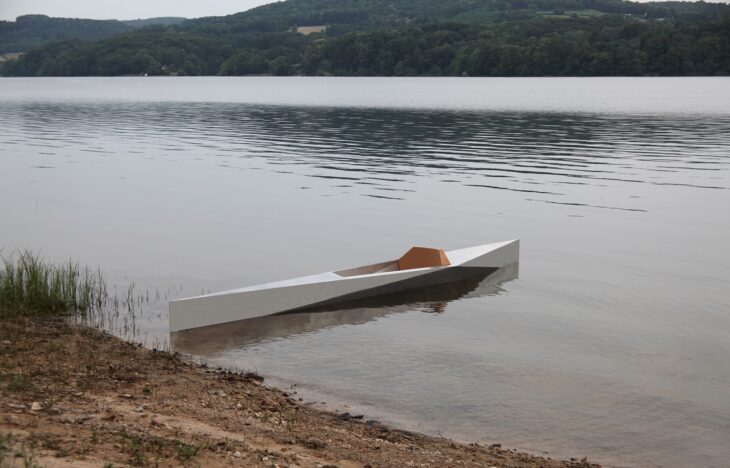
The development of Sharp began with three key elements: a newly acquired press brake, a workshop surrounded by lakes, and a shared interest in boats. Constructed from folded aluminum sheet, the experimental kayak features a double-wall hull that provides structural rigidity and buoyancy while creating its distinctive angular appearance. The idea for the kayak was conceived by Paris-based industrial designer Guillaume Bloget, and realized with craftsman Antoine Rivière through a research-creation residency in a workshop at the Rhizome Association in France’s Morvan region.
The single-person kayak measures approximately 15.6 ft long, 27.6 inches wide, and 12.6 inches high. The project was completed in 2023, following development work conducted during the Rhizome residency in Ouroux-en-Morvan in late 2022 and early 2023.
Sharp’s origins can be traced to both the landscape and the equipment available in the workshop. The workshop is located near several lakes, which prompted Bloget to consider designing a watercraft. Rivière, a boat enthusiast and co-founder of Rhizome, had also obtained a press brake for folding metal sheet. The combination provided a starting point for exploring whether a kayak could be structured primarily through bends in aluminum sheet.
Bloget researched and tested the hydrodynamic form, including the development of scale models before proceeding to the full-size kayak. The objective was to create a lightweight hull that would move smoothly through the water with minimal paddling effort.
Shaping the Aluminum Hull
Rather than relying on a separate internal framework to establish its form, Sharp obtains its rigidity from the geometry of its folded surfaces. The aluminum is formed into an angular, double-wall hull, using the bends to provide both structural definition and an enclosed buoyant volume. According to Bloget, the double-wall construction makes the kayak unsinkable.
The hull’s sharp folds also give the vessel its name and distinctive appearance. Bloget chose to leave the aluminum surface exposed so that its reflective finish could interact with sunlight and the changing surface of the water. Inside the cockpit, a shaped cork seat creates an interface between the paddler’s body and the angular aluminum structure. The natural material also provides a visual and tactile contrast with the metal hull.
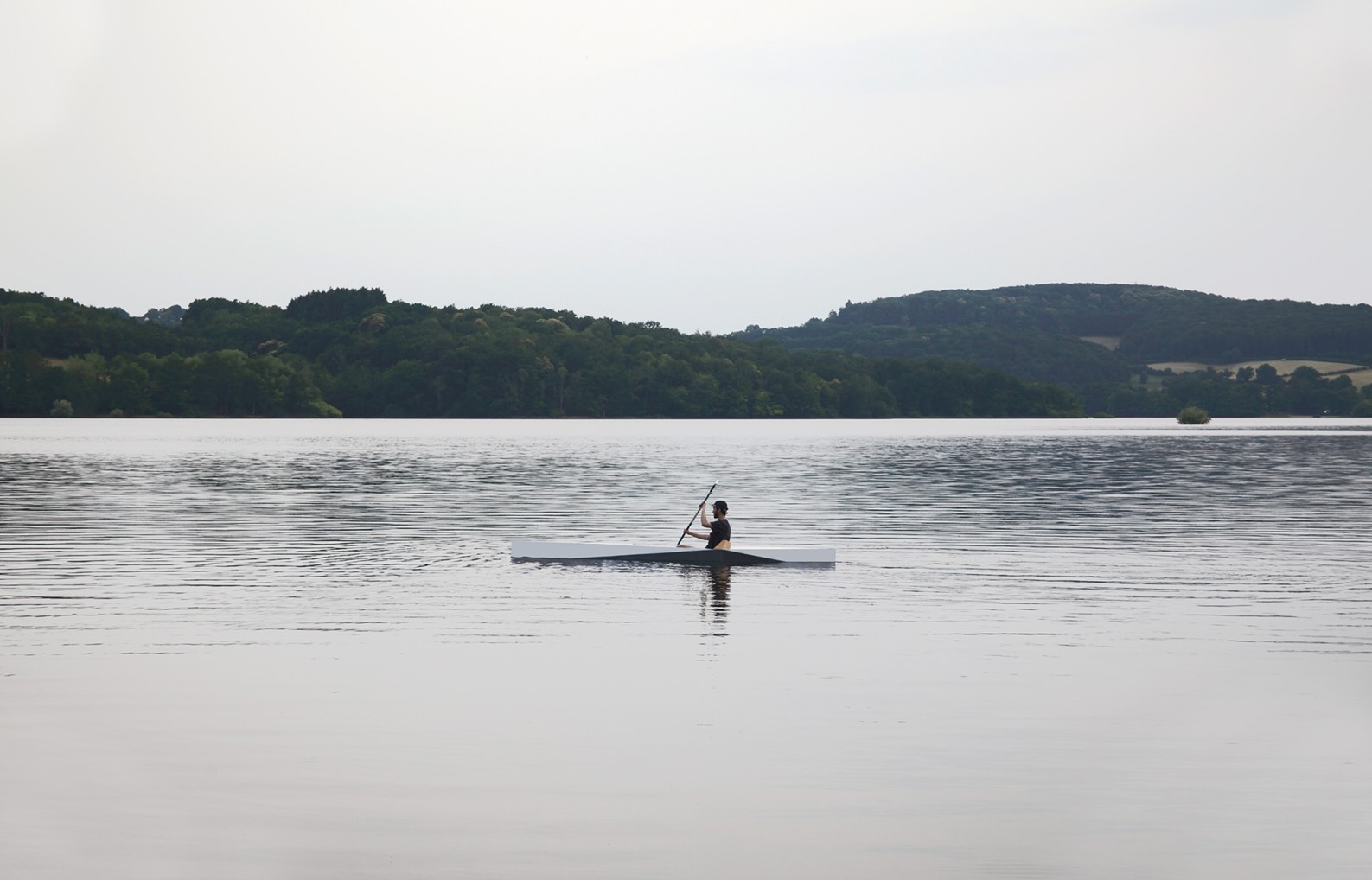
A single fabrication approach was used to develop the hydrodynamic profile, stiffen the sheet, create the double-wall buoyancy structure, and establish the kayak’s visual identity. Although it remains a prototype, Sharp provides an intriguing demonstration of design driven by aluminum-forming technology.
Sharp has subsequently been shown as a design object, including in Bloget’s first solo exhibition at Cité du design in Saint-Étienne in 2024. It is described as a “Mushroom Edition,” implying the potential for future editions, but no commercial manufacturer, price, or production timetable has been announced.
About the Designer
Guillaume Bloget is an independent industrial designer based in Paris, France. After graduating with distinction from ENSCI–Les Ateliers in 2016, he worked with designer Marc Berthier and architect Dominique Perrault before establishing his own studio in 2018. His work explores the relationship between materials, manufacturing techniques, and product use, often bringing industrial processes and traditional craftsmanship together. Bloget has collaborated with companies including Hermès, Ligne Roset, Nemo Lighting, Maison Richard, and Oros. He also co-founded Collections Typologie, which examines the history and manufacture of everyday objects.
About the Rhizhome Association
Founded by Laure Girardeau and Antoine Rivière, the Rhizome Association is a French research-creation organization that supports artists, designers, and researchers through immersive residencies, experimentation, and prototype development. Its facilities include La Tannerie in Avallon and a prototyping workshop in Ouroux-en-Morvan supported by Route Ouest. Residents can explore materials and processes involving metal, wood, glass, ceramics, plastics, and digital fabrication. Rhizome brings creative thinking together with hands-on manufacturing expertise, emphasizing interdisciplinary collaboration, local knowledge, responsible production, and the development of innovative objects and cultural projects.