
By Martin Hartlieb, Viami International Inc.
After a first article on the European Union’s (EU’s) Carbon Border Adjustment Mechanism (CBAM) one year ago (published in the October 2025 issue of LMA, during the mechanism’s transitional phase), CBAM has now been active in its “definitive regime” in the EU since January 1, 2026.1 A year later, on January 1, 2027, the U.K. will be starting its version of CBAM,2 so it is time to have a look at the effects of the mechanism on the aluminum market and its players.
Overview
CBAM is supposed to match the cost of carbon under the EU Emissions Trading System (EU ETS)—a cap-and-trade model—to stop carbon leakage, i.e., to make imports from non-EU countries pay the same price for carbon emissions as local producers. The aim is to avoid having producers of carbon intensive products, like aluminum, relocate their production to countries with looser regulations. Essentially, this extends the EU sustainability standards to its trading partners and promotes global decarbonization. However, aluminum imports from Norway, Iceland, and Switzerland are excluded from CBAM charges.
After a lot of debates, public hearings, adjustments, and simplifications, the current CBAM system now obliges importers (or their indirect customs representatives) of many types of aluminum/aluminum intensive products (exceeding the 50 tons per year “de minimis” threshold) to do the following:3
A. Have their aluminum producers/exporters outside the EU calculate/measure, record, and monitor their direct embedded CO2e emissions according to regulation EU 2023/956 and Implementing Regulation (IR) EU 2025/2547. Unlike for cement and fertilizers, aluminum indirect emissions are not yet considered, only direct process CO2 and perfluorocarbon (PFC) emissions or use country and product-specific default values (established by IR EU 2025/2621, published December 31, 2025 and retroactively corrected with IR EU 2026/1740 in July 2026),4-5 until they have certified actual values. The question of direct versus indirect emissions is obviously a big debate for primary aluminum production, where indirect emissions from electricity generation represent the lion’s share. Regarding country and product-specific values, it is important to document the scrap content and confirm zero-rating for scrap inputs. The EU importer must initiate the request and confirm the producer/exporter is willing to comply, otherwise default values must be used.
B. Commission third-party verification by an accredited and EU recognized verifier (under EN ISO/IEC 14065) with a physical site visit for the first verification period.6 Verifier fees for this range from €5,000 to €50,000 per site. These actual values (or default values)—together with the imported tonnage of aluminum—must be submitted for the CBAM declaration by September 30, 2027, for all of 2026 imports.
C. Apply the free allocation adjustment (the deduction of a percentage of the EU benchmark carbon footprint for the equivalent product, which will be phased out over the coming years)7 and, if applicable, deduct (EU recognized) carbon taxes already paid in their country. It is of note that as of July 2026, no major aluminum-exporting country outside of Norway, Iceland, and Switzerland has a European Commission-recognized qualifying carbon tax scheme for aluminum.
D. Buy CBAM certificates (and get verification4) for the difference (by substracting the value of C from A). These CBAM certificates are non-tradeable and specific to each import’s declared emissions. In this first year (2026), the prices of CBAM certificates have been published quarterly (according to regulation EU 2023/956 and IR EU 2025/2548), reflecting the weighted average auction clearing price of the EU ETS allowances, but as of 2027, this will be a weekly price. The price for the first two quarters of 2026 was just over €75 per ton of CO2. Those certificates will need to be purchased on the common central platform starting February 2027, with the first annual CBAM declaration for 2026 imports due at the latest by September 30, 2027.8
How to Calculate CBAM Costs
The CBAM costs start relatively small, but will increase significantly in the future. Calculated and verified/certified direct carbon emissions of a specific producer or default values for each country and Harmonized System (HS) or in the EU Combined Nomenclature (CN) code (e.g., 7601 for primary unwrought aluminum) are the starting point. Most current smelter’s direct emissions are between 1.5 and 2.1 t CO2e/t Al. To incentivize verified emission calculation and certification, the default values for each country (on which CBAM payments are based) include a mandatory penalty mark-up of 10% in 2026, which will increase to 20% in 2027 and to 30% in 2028 and after.3
Between now and 2034 a so-called “free allocation” will be granted (an amount of CO2e/t Al subtracted from the CBAM carbon footprint of the imported aluminum). It is a percentage of the European benchmark carbon footprint. For primary aluminum, this benchmark is currently 1.423 t CO2e/t Al. This free allocation is phasing out and will increase the CBAM payments every year. It starts this year with 97.5% of the EU benchmark and will reach zero by 2034 (Figure 1).
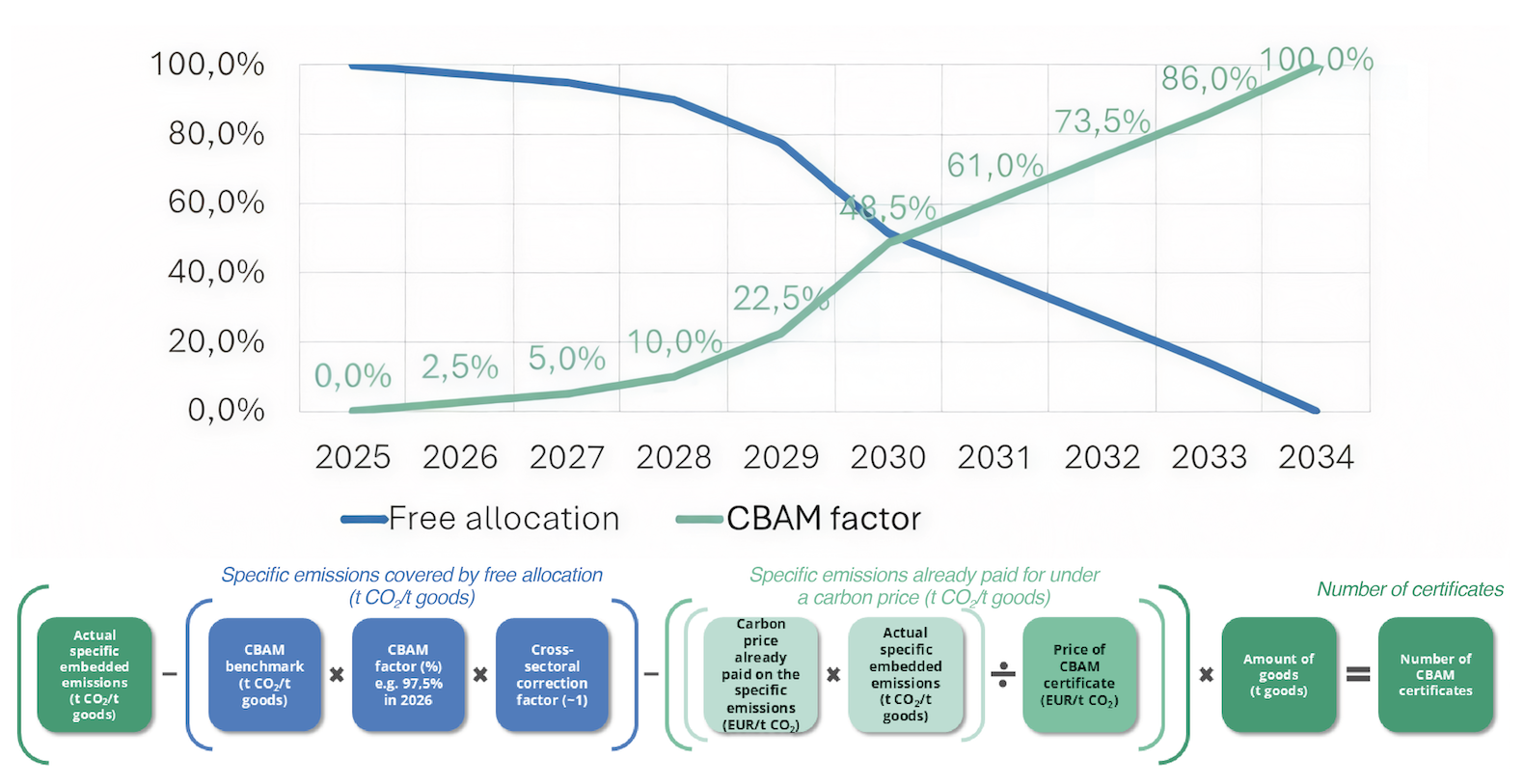
For example, considering imported unwrought primary aluminum from the UAE, with a 2026 default value of 1.870 t CO2e/t Al, for imports during 2026, the free allocation is 97.5% x 1.423 t CO2e/t Al = 1.387 t CO2e/t Al. This means CBAM relevant carbon footprint is 1.870 t CO2e/t Al – 1.387 t CO2e/t Al = 0.483 t CO2e/t Al. This needs to be multiplied with the CBAM certificate price. For example, the Q1/2026 price was €75.36/t CO2 for all imports during the first quarter of this year. This amounts to €36.40 of CBAM charges for every ton of primary unwrought aluminum (HS/CN code 7601) imported from the UAE in Q1/2026. Major publications like S&P Global Platts have already started publishing indications of this as “Aluminum calculated CBAM cost ($/mt),” but the exact CBAM costs for each import needs to be calculated individually as described here.
Secondary aluminum only generates direct emissions between 0.05 and 0.1 t CO2e/t Al and the scrap input itself does not carry any embedded emissions under current CBAM rules. CBAM costs for secondary ingot, billet, sheet, etc. are, therefore, negligible compared to primary aluminum equivalents. However, importers need to request documented scrap contents.
The current CBAM scope excludes HS/CN code 7602 (aluminum waste and scrap). Secondary aluminum is considered zero-rated, if it is made entirely from post-consumer scrap (as this scrap contributes zero to embedded emissions). After significant criticism and claims that scrap content can too easily be used to circumvent CBAM, the EU Council decided to bring pre-consumer scrap into the CBAM scope in June 2026, making traceability of scrap increasingly important. Scrap based products imported under HS/CN codes 7604, 7605, 7606, 7607, or 7616 can reduce their CBAM costs to close to zero by submitting actual verified emissions rather than using default values, and this will become increasingly important in 2027 and after.9
CBAM is likely to change in the future. For aluminum, the Commission already acknowledges that considering only direct emissions for primary aluminum clearly omits the lion’s share of its carbon footprint. As the direct emissions are within a relatively tight range, there is basically no penalty for dirty, high-carbon aluminum and no incentive to produce low-carbon aluminum with renewable energies. Therefore, it is already being discussed that the next phase of CBAM (2028) will possibly include indirect emissions (at least for primary aluminum), which will then of course change the CBAM costs of primary aluminum significantly. The default CBAM values have also been the object of criticism and discussions and might be adjusted upward in the future. The EU ETS itself is currently under review, which could also impact CBAM.
Additional changes are expected regarding downstream products using aluminum, because until now CBAM has only focused on raw and semi-finished products, which creates potential distortion or even incentivizes carbon leaks. The European Commission (EC) proposal COM(2025)989 covers this expansion of CBAM to downstream products (including aluminum components in automotive parts, machinery, and construction products), as well as tighter anti-circumvention rules. Currently, the proposal has been adopted by the council in June/July 2026 and now awaits parliament vote and final procedures, and the institutions are expected to reach a final deal by end of 2026 or early 2027. The expansion will then take effect January 1, 2028. Another issue still to be addressed in the future is European exports and the reduced global competitiveness due to CBAM.
Conclusion and Outlook
CBAM is now active in the EU, with other countries set to follow (such as the U.K. in 2027). Although its monetary impact is still relatively low, it is now becoming a (growing) adder in the typical aluminum pricing formula of LME + regional premium (+ freight + duty, if not included in the regional premium) + CBAM costs. CBAM brings monetary value to carbon emissions in aluminum and its products and makes it important to calculate and demonstrate emissions as well as scrap/recycling contents. It adds complexity and clear necessity for any importer to follow and comply with the (quite complex and changing) CBAM rules.
For many European aluminum consumers, the complexity and uncertainty about CBAM seem worse than the current actual CBAM costs. Many of them push the burden to their suppliers and simply exclude those that cannot guarantee full compliance with CBAM regulation EU 2023/956 and offer prices that include all CBAM charges. Verified low carbon and clearly documented (post-consumer) recycling content are gaining extreme importance. It also seems that several changes to CBAM are likely to occur in the coming years, addressing current issues and criticism. One thing is clear: CBAM will not go away, and in the future, it will cover more and more products containing aluminum.
References
- “CBAM definitive regime,” European Commission.
- “Carbon border adjustment mechanism (CBAM): Policy Summary,” U.K. Government.
- “CBAM Compliance for Aluminium Importers: Annex II Rules Explained,” CBAM Guide, August 15, 2026.
- “CBAM Default Values 2026: Country List, Mark-ups, and How to Avoid Them,” CBAM Guide, August 15, 2026.
- “Commission quietly corrects CBAM default values: IR 2026/1740 applies retroactively from January 1, 2026,” CBAM Guide, August 5, 2026.
- “Verification of CBAM emissions,” Taxation and Customs Union.
- “Gradual CBAM phase-in,” Belgian competent authority for CBAM.
- “Price of CBAM certificates,” Taxation and Customs Union.
- “CBAM Aluminium CN Codes: Chapter 76 Complete List,” CBAM Guide, September 26, 2026.
Editor’s Note: This article first appeared in the October 2026 issue of Light Metal Age. To receive the current issue, please subscribe.