
Emirates Global Aluminium (EGA) and Aluminium Bahrain B.S.C. (Alba) both reported damage to their primary aluminum facilities due to Iranian attacks on March 28.
EGA noted that its Al Taweelah site, which produced 1.6 million tonnes of primary aluminum in 2025, sustained significant damage during the Iranian missile and drone attacks at Khalifa Economic Zone Abu Dhabi. Although a number of employees were injured, fortunately none of the injuries are life threatening.
The company is currently assessing the damage to the smelter. “The safety and security of our people is our top priority at EGA at all times,” said Abdulnasser Bin Kalban, chief executive officer of EGA. “We are deeply saddened and are assessing the damage to our facilities.”
Alba reported that that two of its employees sustained minor injuries during the attacks on its smelter in Bahrain, which is the largest single-site smelter in the world (outside of China). The company is currently assessing the extent of the damage to its facilities and remains focused on maintaining its operational resilience and the safety of its employees.
On March 4, Alba already issued a force majeure on deliveries due to shipping disruptions in the Straight of Hormuz in the Red Sea. The company also initiated a controlled shutdown of Reduction Lines 1, 2, and 3, representing 19% of the company’s total production. The aim of the shutdown was to optimize the Alba’s utilization of existing raw materials inventory and prioritize safety across Reduction Lines 4, 5, and 6 to ensure production resilience. It is not clear to what degree the recent attacks have impacted this controlled shutdown or overall production.
In addition, Qatalum had initiated a controlled shutdown of its operation in Qatar on March 3 due to a shortage of natural gas, following Iranian attacks on Qatar’s LNG production. Qatalum is currently holding aluminum production at 60% capacity, after it was confirmed that gas supply could be maintained at reduced levels.
Impact on Global Markets
The Aluminum Association responded to the March 28 attacks on EGA and Alba, noting that it was monitoring the ongoing situation in the Gulf region and the implications for the domestic aluminum industry. “While the current conflict is a global security issue that goes far beyond the interests of any single industry,” the Association noted that it is “increasingly concerned about the safety of aluminum workers and broader market impacts.”
For reasons of geography, geology, and affordable energy availability, aluminum’s supply chains are globally integrated. Gulf Cooperation Council (GCC) countries account for a meaningful share of global aluminum production and U.S. imports today. The GCC aluminum sector supplies ~9% of global unwrought aluminum and made up roughly 21% of unwrought aluminum imports and 13% of wrought aluminum imports into the U.S. in 2025, which is up significantly from 2024 and at or near record levels (Figure 1).
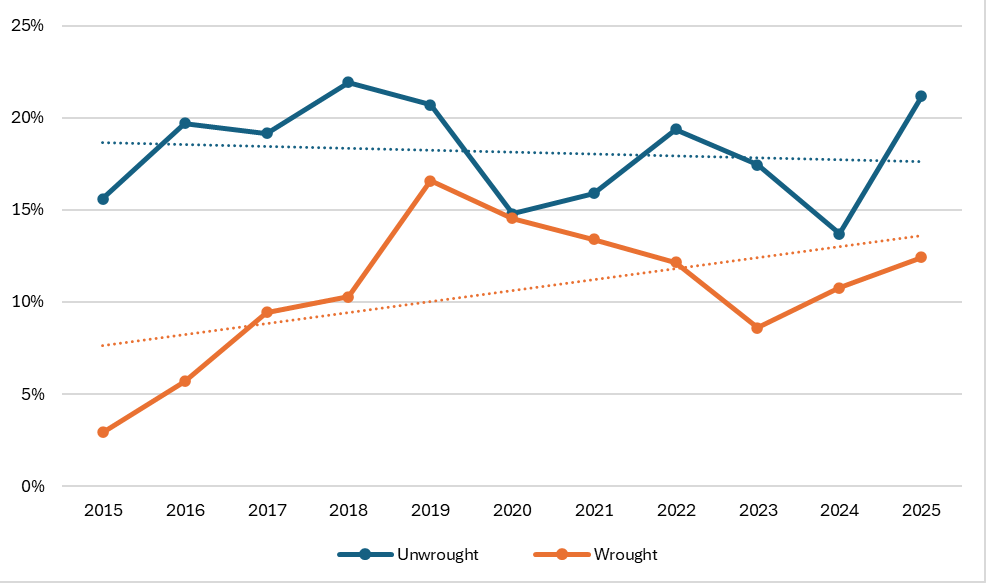
To date, companies in the region have announced ~500,000–600,000 tonnes of aluminum production curtailments caused by energy availability and other challenges. These curtailments were announced before reported attacks on aluminum infrastructure on March 28.
According to the Aluminum Association, disruptions in the region — both direct and indirect — are impacting aluminum trade flows and logistics. While markets remain supplied in the near term, continued instability could create longer-term challenges particularly for certain types of primary aluminum products. The closure of the Strait of Hormuz has made both shipping aluminum out and shipping input material (like alumina) into the region extremely difficult, and recent direct attacks on aluminum facilities are of growing concern.
In a recent webinar, CRU reported on the potential impact of prolonged conflict in the Middle East. According to Alex Christopher, senior analyst – Aluminium, CRU, the aluminum industry is already in a global deficit, with low stock levels. If there continues to be a meaningful reduction of production in the Middle East, then this deficit could double, especially since there is not a readily available supply to fill the gap. This could potentially push prices as high as $4,000 per tonne or more, which would be “an exceptional level historically speaking.”
“The apparent targeted attacks on aluminum assets in the Gulf are troubling, and we’re relieved to hear there were no fatalities at these facilities,” said Charles Johnson, president and CEO of the Aluminum Association. “Aluminum firms are working around the clock to mitigate impacts and adjust operations and supply routes as needed. The association is in close contact with our member companies as this situation evolves and will continue to track developments for market impacts. This industry has a proven track record over more than a century of adapting to regional and global challenges while continuing to meet the evolving needs of our customers.”