
By J.P. Weiler, Meridian Lightweight Technologies, Inc.
For more than three decades, automotive lightweighting has been the primary growth market for magnesium alloy applications. Advances in high-pressure die casting, alloy development (including high-purity alloys), corrosion protection, and joining technologies have enabled the introduction of magnesium components, ranging from steering wheels and seat frames to structural cross-car beams and closure inners. Yet, the automotive industry has entered a period of relative slow progress. Electrification, while still supporting lightweighting, has shifted attention toward battery chemistry, software, and vehicle integration, reducing new structural material adoption. At the same time, an entirely new industrial ecosystem is emerging around artificial intelligence (AI).
AI is transforming far more than software. Hyperscale data centers, autonomous mobile robots, collaborative robots, humanoid robots, drones, and intelligent manufacturing systems are driving a rapidly expanding economy. Unlike mass-market automotive products, many of these systems are relatively high-value and performance-driven. In such products, the cost of material can be less important than its effect on energy consumption, payload, precision, thermal management, reliability, and manufacturing efficiency.
This creates a new opportunity for magnesium. Its low density is one of the key benefits; however, its alloys also combine lightweighting with vibration damping, high specific stiffness, electromagnetic-interference (EMI) shielding, and excellent die-casting capability. In moving systems, reducing structural mass can also create cascading benefits. The growth potential of magnesium is, therefore, related to identifying applications where magnesium’s combination of properties creates a measurable system-level advantage.
Artificial Intelligence Hardware
Discussion of AI has been dominated by algorithms and large language models. Yet, every AI application is tied to physical infrastructure (Figure 1). The growth in AI capability and adoption will ultimately drive investment in infrastructure and increasing electricity demands from data centers.1,2
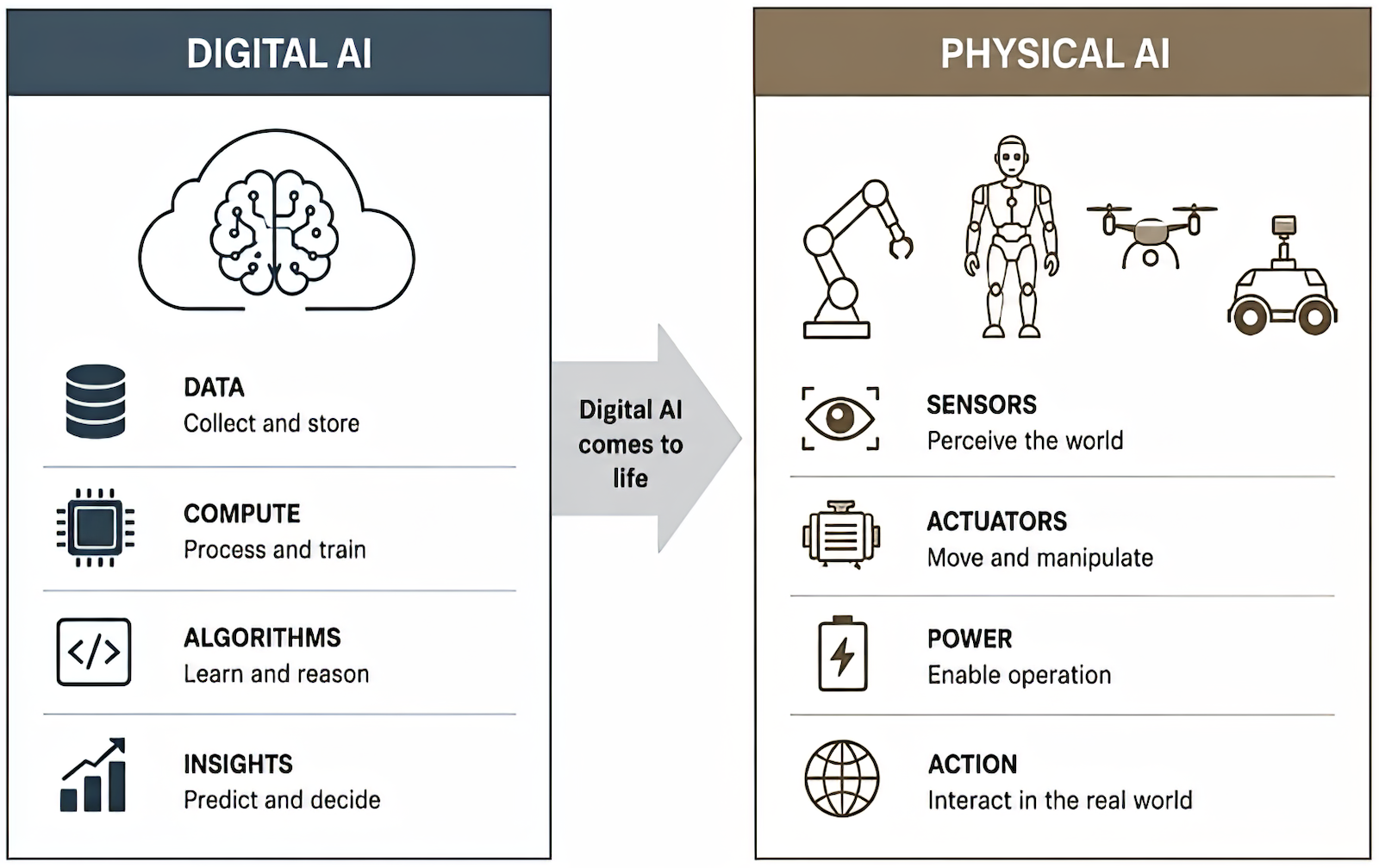
The physical AI economy extends well beyond computing. Industrial robots, autonomous mobile robots (AMRs), and drones are among a number of new applications, seeing over half a million industrial robots installed globally in 2024, over twice the amount from ten years earlier.3
Intelligent machines must carry batteries, processors, sensors, actuators, communication hardware, and payloads, while continuously accelerating and decelerating. Weight affects much more than transportation energy. It influences actuator size, joint loads, battery capacity, thermal management, stability, and dynamic response.
Why Magnesium Fits Intelligent Machines
Magnesium alloys have a density in the range of 1.80 g/cc, making magnesium the lightest structural engineering metal. Its established applications in transportation, aerospace, electronics, and portable equipment demonstrate that it can provide lightweight structures, while also offering castability, dimensional stability, damping, and EMI shielding.4–8
The most important opportunity in robotics is systems lightweighting. Consider traditional automotive lightweighting, where a kilogram removed from an automobile primarily improves efficiency or range. A kilogram removed from a mobile robot results in a potential benefit cascading throughout the system. A significant proportion of a humanoid robot’s structural mass is contained in its torso, pelvis, arms, and joint housings. The first-order saving is straightforward, but the second-order effects can be more important. Lower inertial loads reduce torque requirements during acceleration and deceleration. Lower torque can enable smaller motors and gearboxes. Smaller drives reduce electrical consumption and heat generation. The resulting reduction in battery and cooling requirements can further reduce total mass.
Weight reduction is only one aspect of performance. Intelligent machines must also move accurately. Unlike automobiles, robots frequently accelerate, decelerate, and change direction rapidly. These dynamic events generate structural vibrations that can influence positioning accuracy and cycle time. Magnesium offers an often-overlooked advantage in this area. Its alloy systems can exhibit excellent intrinsic damping, making magnesium attractive where vibration suppression and rapid settling are important.5
Manufacturing integration provides another advantage. Magnesium’s excellent castability allows ribs, bosses, cable-routing features, attachment points, and other functions to be incorporated into thin-wall components. Part consolidation can reduce assembly time, fastener count, dimensional variation, and potential failure points. The automotive magnesium industry has already developed much of the process knowledge needed to transfer this philosophy into robotics.4–7
EMI shielding adds another layer of functionality. Magnesium is electrically conductive and can serve as a lightweight electromagnetic shield around processors, sensors, communication equipment, and motor-control electronics. The relevance of the capability of magnesium alloys to provide EMI shielding has been demonstrated in increasingly electronics-intensive systems.8
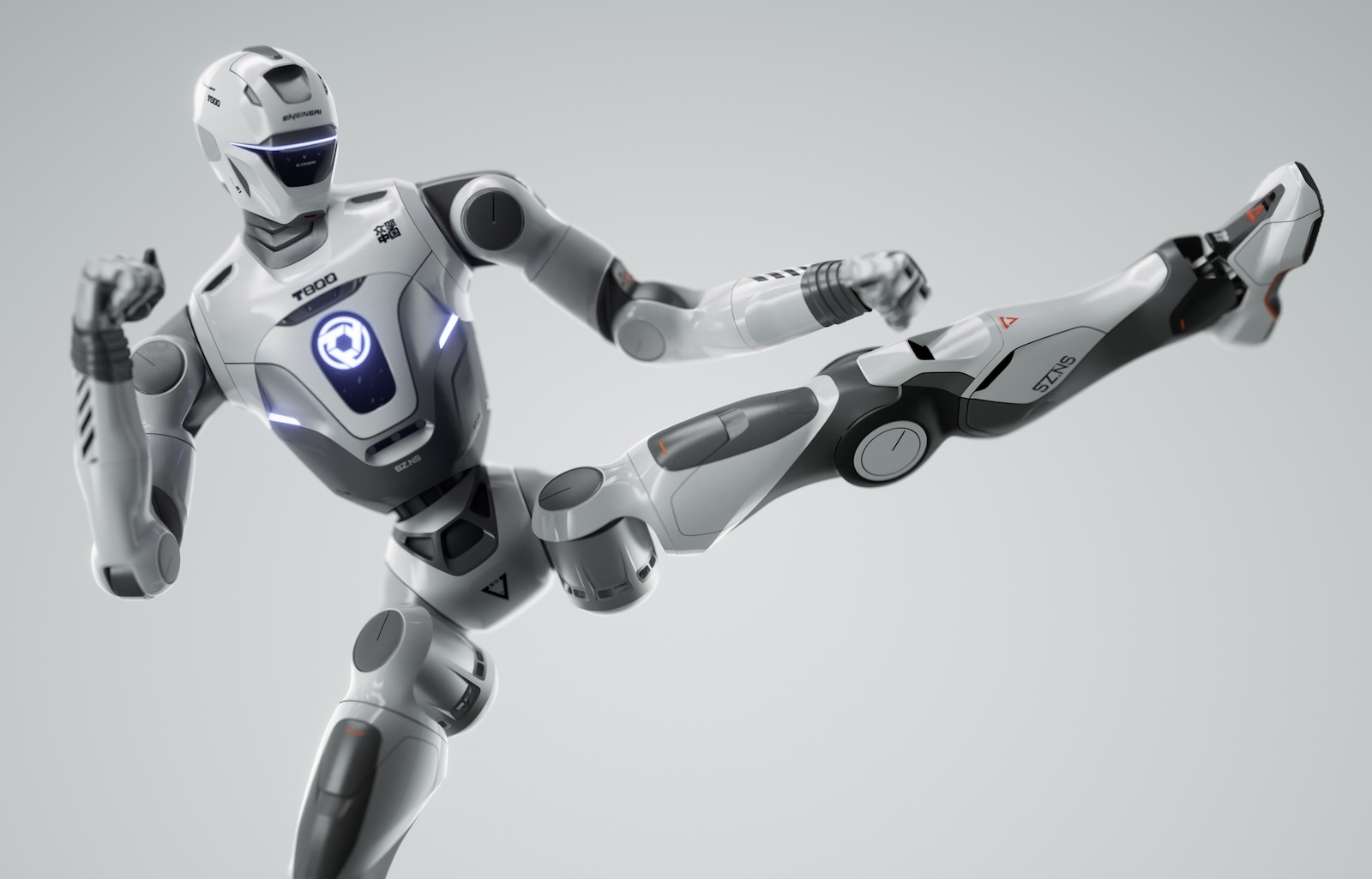
Several humanoid robot manufacturers have already implemented magnesium into their designs. For example, Kawasaki has implemented magnesium in structural components for its Kaleido series9 and Zhongqing Robotics uses magnesium in its EngineAI T800 general purpose robot, which possesses an aerospace-grade ultra-light magnesium-aluminum alloy casing (Figure 2).10
Manufacturing the AI Economy to Scale
The transition from prototype robotics to high-volume production will make manufacturing economics increasingly important. Current robotic systems often contain large numbers of machined, fabricated, and fastened components. This approach is suitable for development but becomes expensive as volumes increase.
High-pressure die casting offers a route to structural integration. A single magnesium casting can potentially replace multiple brackets and fabricated parts, while incorporating ribs, bosses, and mounting interfaces. The result can be fewer parts, fewer assembly operations, and improved dimensional consistency.4–7
Semi-solid processing, including magnesium thixomolding, provides another route for precision components. Magnesium feedstock is processed in a semi-solid state before injection, allowing complex shapes to be produced with relative low turbulence and good dimensional control. Its relevance to AI hardware lies in applications where thin walls, intricate geometry, and high repeatability are important.
These manufacturing technologies also create an opportunity to transfer automotive knowledge into robotics. The magnesium industry already understands die design, alloy selection, corrosion protection, machining, recycling, and quality control at industrial scale. Robotics companies entering mass production do not need to develop this knowledge independently if they engage with an established magnesium supply chain.
AI-Assisted Magnesium Development
The relationship between AI and magnesium extends beyond applications. AI is also becoming a tool for designing the material itself.
Machine-learning methods can identify relationships among alloy composition, processing conditions, microstructure, and properties. Recent studies demonstrate the ability of machine learning to predict mechanical properties and accelerate alloy screening, while Integrated Computational Materials Engineering (ICME) provides a framework for combining thermodynamic calculations, process simulation, and mechanical modeling.11–13 Further work is also ongoing to assemble an integrated materials selection and intelligence platform spanning the industrial value chain for magnesium alloys in an effort to expedite AI-assisted developments.14
These works could accelerate magnesium alloys with improved creep resistance, corrosion resistance, thermal conductivity, ductility, and tolerance to recycled feedstocks. It could also support application-specific alloy design rather than relying primarily on a small number of general-purpose commercial compositions.
Improving manufacturing processes is another opportunity. Magnesium manufacturing performance is influenced by a combination of metal temperature, velocity, pressure, die temperature, and cycle times. Machine learning could identify relationships that are difficult to capture with conventional process windows. Predictive quality systems could reduce scrap and improve process stability.
In this sense, AI creates a two-way relationship with magnesium. AI can become a new source of magnesium demand, while magnesium development can benefit from AI-enabled materials and manufacturing science.
Regional Growth Opportunities
The geography of AI and robotics developments is more diverse than the geography of the current magnesium production industry. That difference creates both opportunities and challenges.
North America is a major center for hyperscale AI investment and venture-backed robotics. The U.S. hosts the largest concentration of AI data centers, while Canada has emerging strengths in AI research and robotics. This region offers opportunities for magnesium suppliers serving robotics, defense, advanced manufacturing, and edge-computing applications.1
Europe has strong industrial-automation and robotics capabilities and is placing increasing emphasis on sustainable manufacturing. Magnesium applications that combine lightweighting with material efficiency and recyclability may benefit from this environment.
Asia remains central to both robotics manufacturing and electronics. China accounted for 54% of global industrial-robot installations in 2024, while Japan and South Korea maintain highly developed robotics and electronics industries.3 China also has an extensive magnesium production and processing ecosystem, giving it an advantage in commercializing magnesium-enabled AI-related developments (Figure 3).
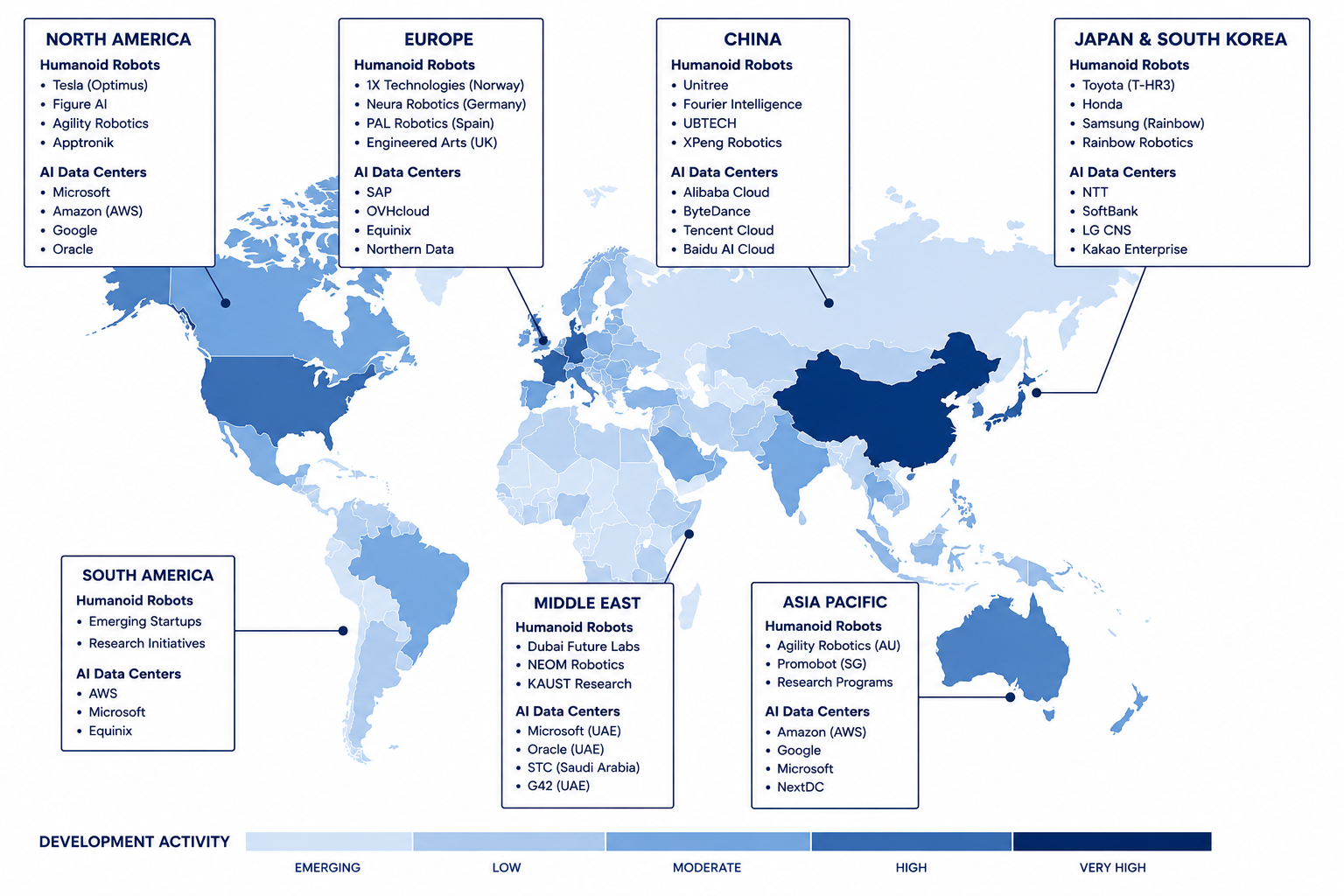
The Middle East is an emerging market for AI infrastructure, with large investments in data centers and sovereign computing. While local magnesium manufacturing is limited, AI infrastructure could create demand for imported advanced equipment and provide future opportunities for regional manufacturing partnerships.
Early engagement with robotics developers, equipment manufacturers, and advanced-materials programs may be a valuable action for magnesium producers and manufacturers.
The Next Decade
In the next several years, we will see very rapid developments in AI and robotic applications. Humanoid robots remain an emerging product category, data-center equipment is dominated by established materials, and many potential applications have yet to progress through qualification.
The opportunity for magnesium is nevertheless significant, because AI is creating products with a different relationship between material cost and system value. In a mass-market automobile, a small material-cost increase multiplied across millions of vehicles can be decisive. In a high-value robot, drone, or specialized AI system, a material that improves energy consumption, precision, payload, reliability, or assembly can justify a higher material cost.
The most promising alloys will be engineered for specific combinations of properties. This includes low density and damping for moving structures, creep resistance and dimensional stability for actuator housings, corrosion resistance for harsh environments, thermal performance for selected electronics applications, and compatibility with recycled material streams.
Manufacturing development should similarly emphasize ultra-thin-wall casting, vacuum high-pressure die casting, integrated structural castings, semi-solid processing, digital process control, and AI-assisted quality optimization.
Conclusion
The magnesium industry’s future has historically been closely tied to automotive lightweighting. AI and robotics offer an opportunity to broaden that market by creating a new class of products in which mass, motion, electronics, and energy consumption are tightly interconnected.
The strongest magnesium opportunities will come from applications where several magnesium characteristics provide value simultaneously: low density, damping, EMI shielding, castability, and functional integration.
Robotics is the clearest example. A lighter structural component can reduce actuator requirements, battery demand, and thermal loads while improving dynamic response. Drones offer another compelling application because mass directly affects payload and endurance.
Perhaps most importantly, AI is also becoming a tool for advancing magnesium technology itself. Machine learning, ICME, digital process control, and predictive quality systems can accelerate alloy development and manufacturing optimization.
As AI moves from algorithms into machines that sense, move, compute, and act, magnesium has an opportunity to evolve from a lightweighting material into an enabling material for the intelligent age.
References
- “Artificial Intelligence Index Report 2026,” Stanford Institute for Human-Centered Artificial Intelligence (Stanford HAI), 2026.
- “Energy and AI,” International Energy Agency (IEA), April 10, 2025.
- “Best-Of World Robotics 2025,” International Federation of Robotics (IFR), 2025.
- Zhang, J., et al., “Magnesium research and applications: Past, present and future,” Journal of Magnesium and Alloys, Vol. 11 No. 11, November 2023.
- Friedrich, H.E. and B.L. Mordike, Magnesium Technology: Metallurgy, Design Data, Applications, Springer, 2006.
- Avedesian, M.M. and H. Baker, ASM Specialty Handbook: Magnesium and Magnesium Alloys, ASM International, 1999.
- Pollock, T.M., “Weight Loss with Magnesium Alloys,” Science, Vol. 328, 2010, pp. 986–987.
- Ashraf, M.N., et al., “Historical Progress in Electromagnetic Interference Shielding Effectiveness of Conventional Mg Alloys,” Advanced Engineering Materials, Vol. 25, No. 21, November 2023.
- “Humanoid Robot: The Evolution of Kawasaki’s Challenge,” Kawasaki, January 15, 2026.
- “Full-Size, High-Dynamic General-Purpose Robot: Engine AI T800,” Zhongqing Robotics, accessed August 26, 2026.
- Valipoorsalimi, P., Sari, Y.A., and Pekguleryuz, M., “Mechanical Property Design of Bio-compatible Mg alloys using Machine-Learning Algorithms,” ResearchGate, May 2023.
- Nandal, V., et al., “Accelerating the Design of Resorbable Magnesium Alloys: A Machine Learning Approach to Property Prediction,” Materials & Design, Vol. 266, June 2026.
- “Computational Materials Sciences: Materials Genome Initiative,” U.S. National Science and Technology Council.
- “DSPRC Magnesium Industry Data System,” International Magnesium Society Ltd., accessed August 27, 2026.
Editor’s Note: This article first appeared in the October 2026 issue of Light Metal Age. To receive the current issue, please subscribe.