
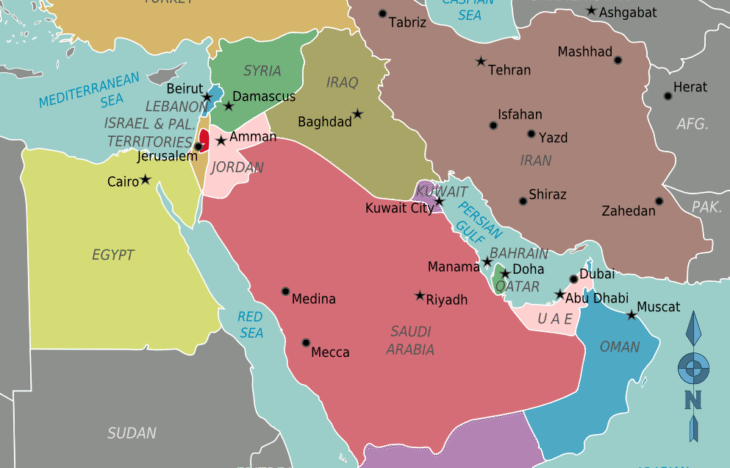

In the wake of Israel and the U.S. launching coordinated joint attacks on Iran, CRU Group released a webinar exploring how conflict in the Middle East will affect the metals industries. Hosted by Alex Tuckett, head of Economics, with Alex Christopher, senior analyst – Aluminium, presenting the aluminum perspective, delved into both the short term and long term impact on the industry.
Impact on Production
The Middle East has two bauxite mines, three alumina refineries, and 11 aluminum smelters, located across Bahrain, Iran, Oman, Qatar, Saudi Arabia, and the United Arab Emirates. The region generates around 6-7 million tonnes of aluminum (representing 22% of production outside of China and 9% of total global capacity).
Christopher pointed out that there are two situations going on in the region. On the one hand, there are smelters like Ma’aden, which is an integrated complex comprising a bauxite mine, an alumina refinery, and a smelter, making the company self sufficient. However, other smelters could see their ability to import resources affected by disruptions in shipping through the Straight of Hormuz in the Red Sea. Similarly, smelters in the region will be challenged to export finished aluminum in turn. The smelters could also face direct damage to their facilities, if the conflict spreads.
Already, Qatalum announced it was initiating a controlled shutdown of its smelter in Qatar in response to QatarEnergy cutting back LNG production after attacks from Iran. The move will enable the company to minimize the health, environment and safety risks, while shutting down and preparing the operation for a future restart.
Christopher pointed out that there are different levels of curtailments, which have an impact on how quickly a smelter can be restarted. First off, a planned curtailment itself takes around a month. Then, the time it takes to restart depends on the following conditions:
- If a smelter is hot idled, with the pots maintained and still holding hot metal, then the restart process could be around 1-3 months.
- If it is cold-idled, with the pots emptied and the infrastructure well-maintained, then restart could be around 6-12 months.
- If the smelter is mothballed and the infrastructure is left alone, then it would be over 12 months at the very least to bring it back online.
- If it’s a situation when the power is suddenly cut and the pots freeze, then it would take much longer, because the metal needs to be cleaned out before even starting the restart process.
He noted that since Qatalum is a controlled shutdown, the company will likely be able to restart capacity in 5-6 months (if it ends up being a full curtailment). During this time period of curtailment and slow restart, there’s an inherent disruption to production over an extended period.
In addition, Aluminium Bahrain (Alba) issued a force majeure on deliveries due to shipping disruptions. If the Strait of Hormuz continues to be blocked, more smelters in the region could declare force majeure, as they are unable to ship metal out or bring resources in. If Alba, Emirates Global Aluminium (EGA), and other smelters in the region can’t ship out their aluminum as time goes on, then they will have to make decisions on curtailments, which will impact global supply.
When asked how the conflict might impact the smelter industry in Europe, Christopher noted that gas and energy supply in Europe will likely skyrocket in Europe by around 60-80%. How this impacts European smelters depends on whether the facility has a power purchase agreement (PPA) or not. Those smelters with PPAs will be able to continue to pay the set prices outlined by their agreement. However, those smelters in Europe exposed to spot pricing will likely experience a high degree of pressure. And the longer the conflict goes on, Christopher explained, the greater chance that this could lead to curtailments.
Christopher also addressed a question about whether or not China might lift its aluminum production cap. He explained that since 2017, China has capped its aluminum smelting capacity at 45 million tonnes. Currently, the country is approaching that cap, with over 44 million tonnes of production. However, he notes that the Chinese government seems to be serious about this cap, as evidenced by China’s investment in other regions, including Indonesia, Angola, and so on. Therefore, it would take an exception situation for China to remove this cap, and it’s an open questions as to whether it could be raised, if supply disruptions in the Middle East become more significant.
Impact on Aluminum Prices
According to Christopher, the aluminum industry is already in a global deficit, with low stock levels. If there continues to be a meaningful reduction of production in the Middle East, then this deficit could double, especially since there is not a readily available supply to fill the gap.
For instance, he noted, there is a limited amount of idled capacity that could be brought back online. Both Europe and North America would be challenged to restart idled capacity. In Europe, this involves a number of challenges beyond prices, specifically labor issues. In the U.S., aluminum smelters are having to compete with data centers for access to energy.
In 2026 or 2027, Indonesia is expected to start up a significant amount of primary aluminum capacity. However, Christopher said that even with this supply coming online, there will be a gap — with the already tight market getting much tighter before there is any relief from Indonesian supply.
Christopher explained that if more Middle East smelters curtail their operations or experience restrictions in their exports, this capacity will not be readily replaced. As a result, aluminum prices could be pushed toward $4,000 per tonne, which would be “an exceptional level historically speaking.” This, coupled with more expensive regional premiums and freight costs could result in challenging market conditions.
Editor’s Note: Learn more about CRU Group and their global metals insights and forecasts on their website.